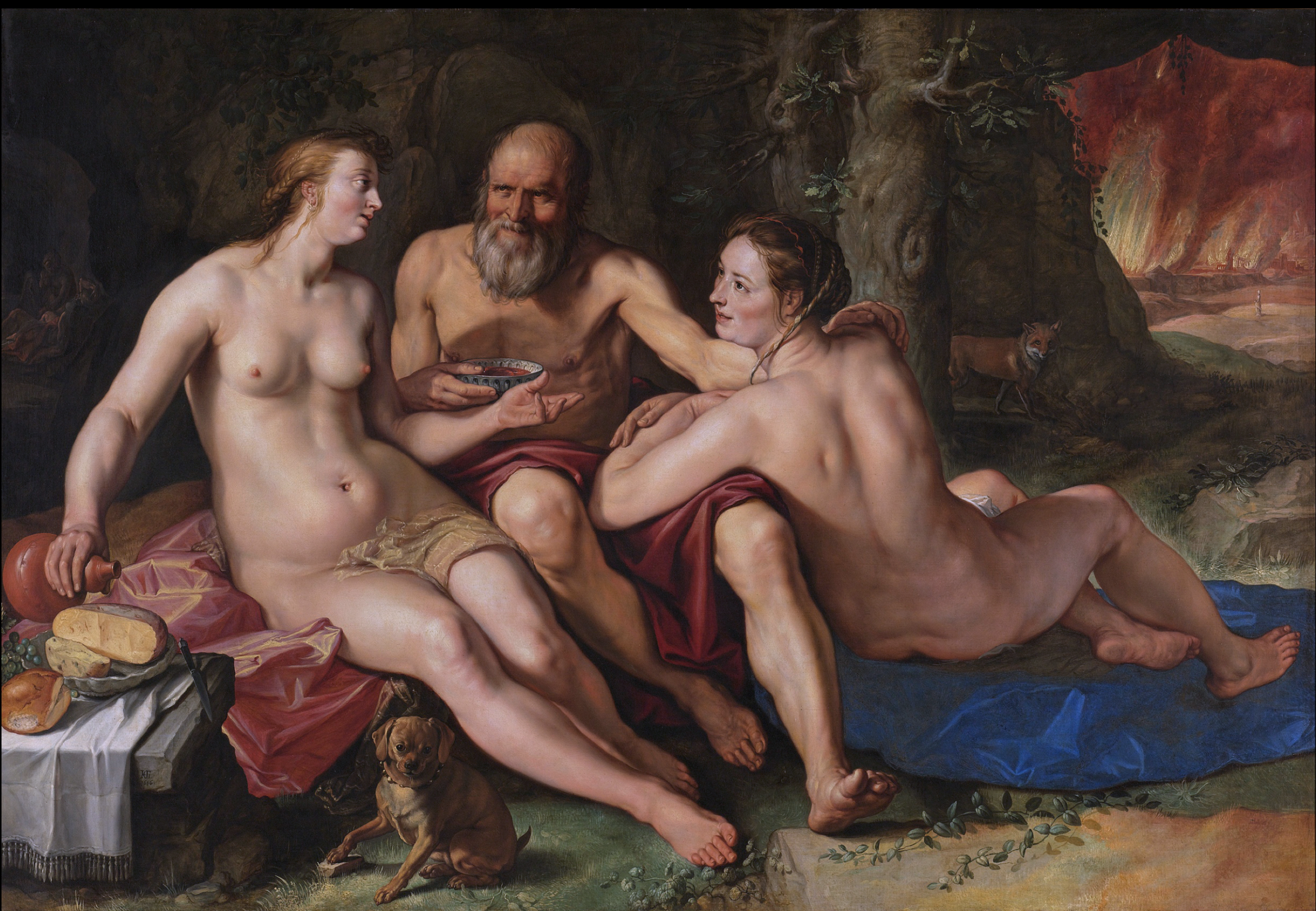
Hendrik Goltzius, Lot and His Daughters, 1616, Rijksmuseum
By Patrick Hunt –
The sordid story of Lot, errant nephew of Abraham and his opposite in nearly every way – the man of flesh as counterpoint to the man of faith – is one of the saddest Genesis expository examples in the biblical narratives. Regardless of one’s belief or not on the veracity of the ancient text, the literary genius describing the folly that Lot repeatedly chose is an undeniable peripety of his fate from inherited blessedness to manifest curse. Whereas Abraham generally lived in a tent befitting his occupation of animal husbandry in the hills, Lot preferred the urban degradation of Sodom, ill-fated city of the Jordan plain. Abraham had given his beloved nephew – son of his brother Haran – the option of drier grazing hills or fertile plain. Lot assumed he took the better real estate in the Jordan plain.
But in Genesis 18 the cries against Sodom and Gomorrah’s predatory behavior had risen to God’s “ears” (18:20 “…how great is the outcry against Sodom and Gomorrah”) as the narrative develops the moral lesson of Lot. So God gave ample warning that he would destroy the two viper pits that were completely given over to the depravity of their predatory lifestyles, likely the result of sexual obsessions as Genesis 18 reads. In Genesis 19 the rain of fire in sulfur and brimstone is somehow alluded to by the fires of lust that burned in the residents of those cities. Even temporarily fleeing to the small town of Zoar was not enough to save the family of Lot’s compromised lifestyle even after fleeing Sodom. Lot himself soon ended up in a mountain cave with his daughters after his wife disobeyed the angelic command not to look back at her home. In the story Lot’s wife ended up herself as an inert pillar of salt as she trailed behind her fleeing family, not wanting to give up her comfortable urban life, however compromising to her and her family.
The irony of Lot and his daughters leaving an urban lifestyle to end up in a cave may be a strong suggestion of devolution rather than evolution, as if Lot was slipping back into deep prehistory by becoming a cave dweller with the reversing loss of redeeming civilizing behavior only to fall upon his basest instincts.
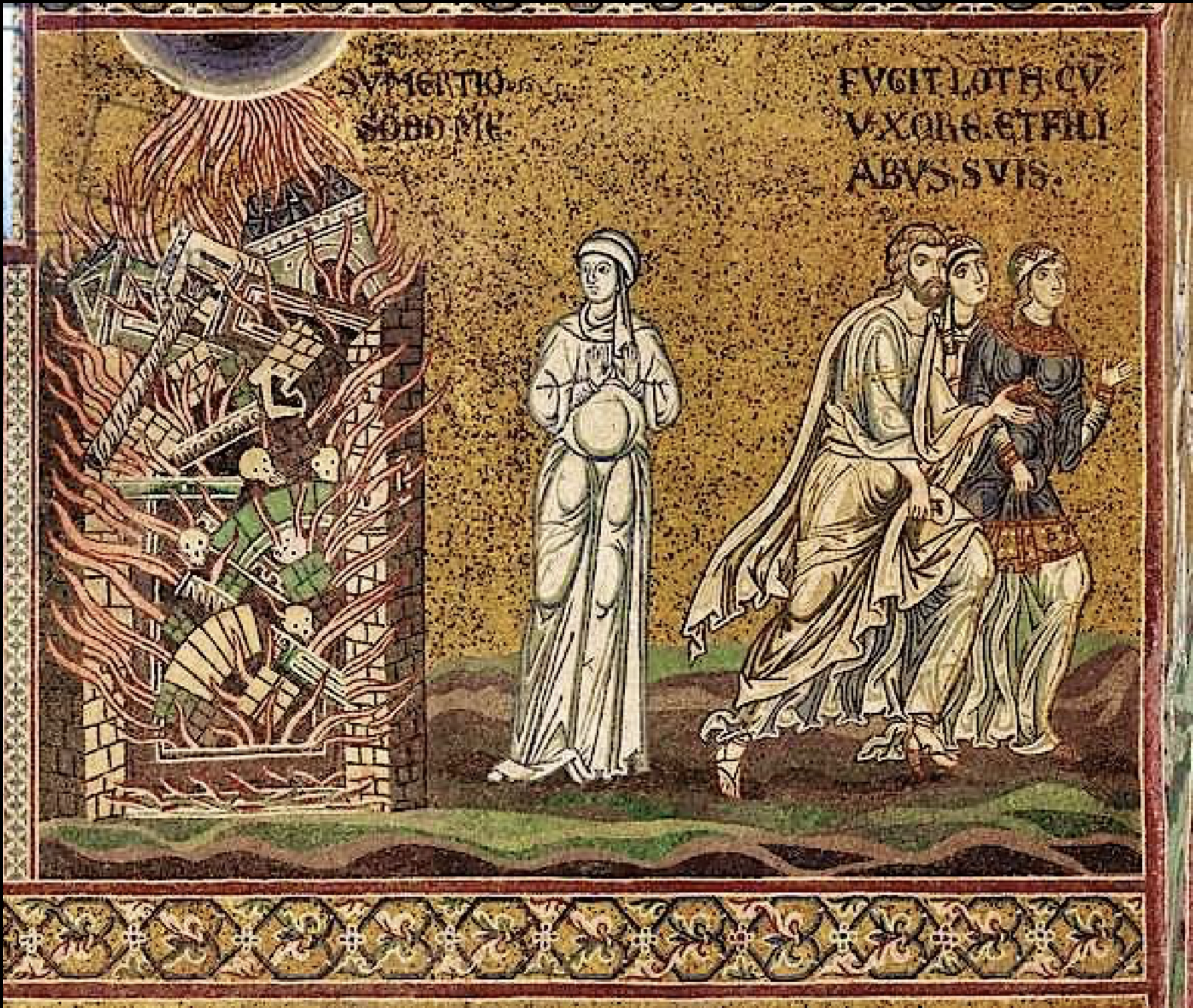
Lot’s family Fleeing Sodom and Lot’s Wife as a Pillar of Salt, 12th c. mosaic, Monreale Cathedral
Intriguingly, art has often depicted the final degradation of the incest between Lot and his daughters. Although the literary tale can be seen in medieval art renditions such as in 12th century Byzantine style mosaic vignette at Monreale Cathedral where the mosaic only shows them fleeing and Lot’s wife already cessile. Renaissance examples are from Lucas Cranach ca. 1530 who also painted the story multiple times. Later, the story of Lot and his daughters appears fairly frequently in Baroque paintings in a short time frame. For example, Peter Paul Rubens depicted it twice (Schwerin Staatliches Museum, 1610, and the Metropolitan Museum New York, 1614). Rubens was noted for psychological probity in these renderings as Eaker shows. An equally-graphic exbut ample is by Hendrik Goltzius (Rijksmuseum, 1616). Other renditions are by Giovanni Francesco Guerrieri (Borghese Gallery, 1617), Simone Vouet (Musée des Beaux Arts Strasbourg, 1630) and Orazio Gentileschi (Berlin Gemäldegalerie, 1637), although other works can also be found but not cited here.
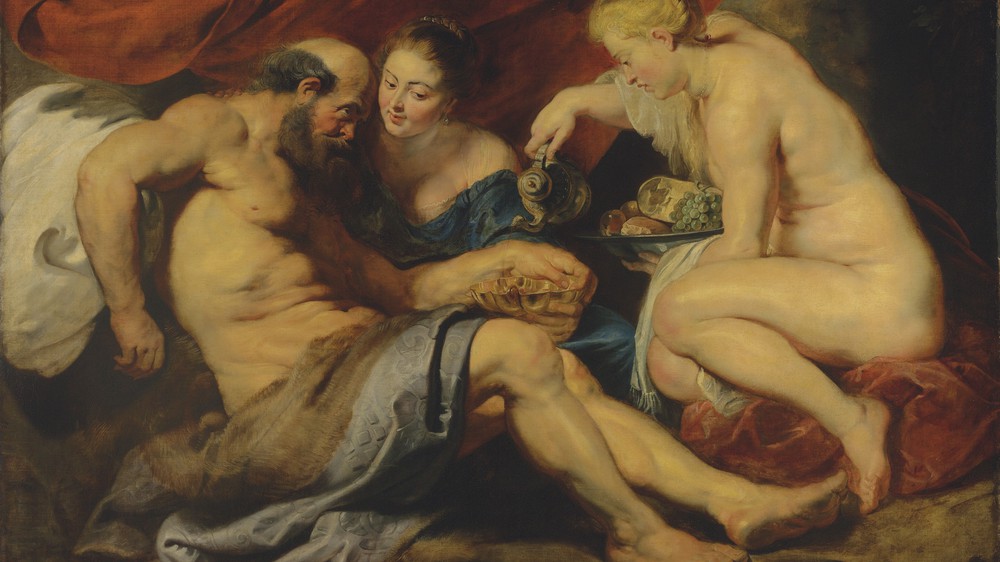
Peter Paul Rubens. Lot and His Daughters, ca. 1613-14. Metropolitan Museum of Art NY (Image courtesy of MMNY)
Rubens shows a dissipated Lot barely able to stay upright or to hold on to his wine vessel only with the help of a daughter whose hand stabilizes it underneath. On the other hand, Lot’s focus appears fixated on a daughter in a way that is almost scary – with one thing on his otherwise benumbed mind.
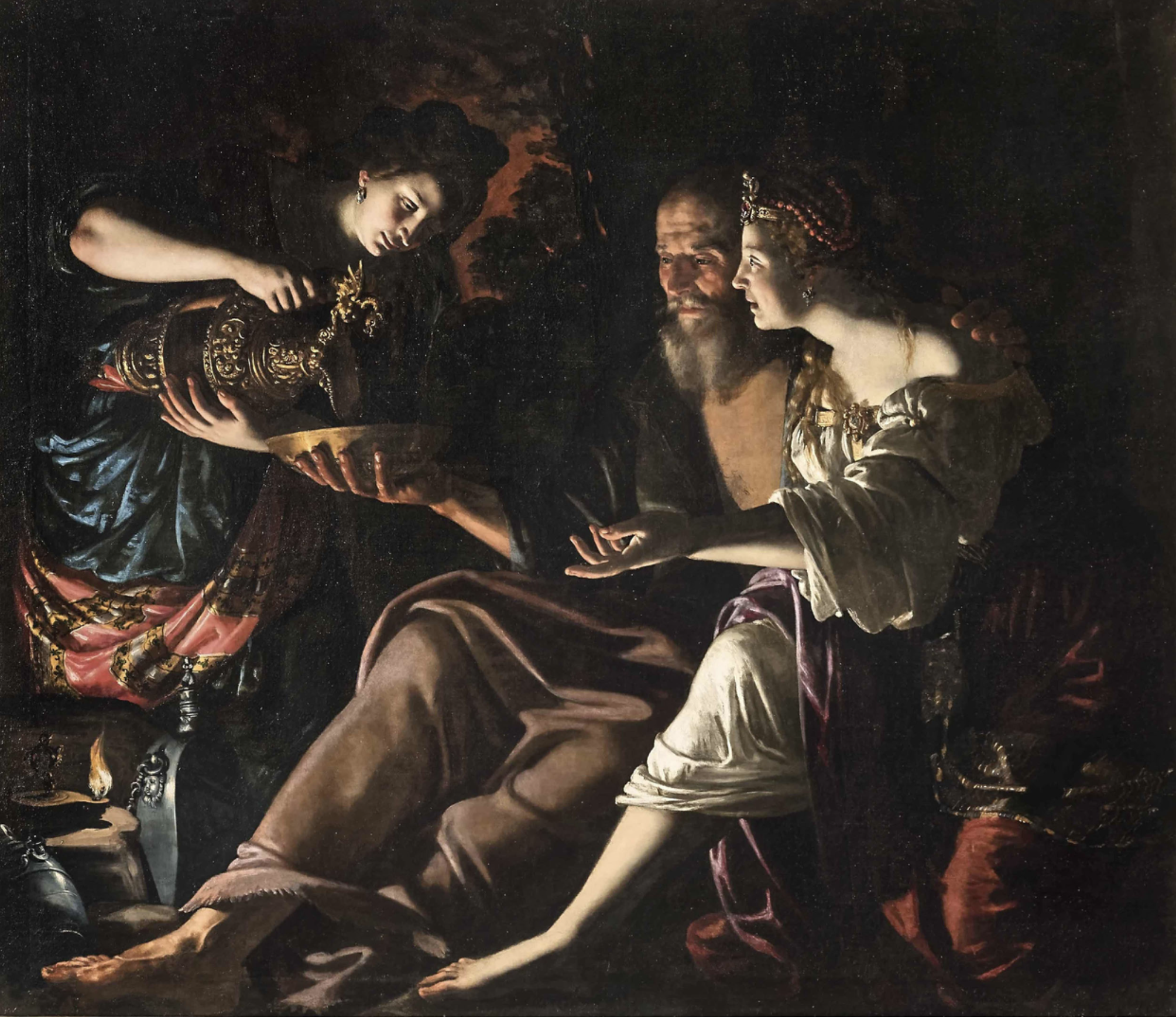
Giovanni Francesco Guerrieri. Lot and His Daughters, 1617. Borghese Gallery Rome (Photo P. Hunt, 2026)
The basic image iconographic attributes (visual clues) for the story of Lot and his daughters only require an old man, two young women and wine in some form. Both Guerrieri and Gentileschi follow the basic iconography without much embellishment, and Gentileschi is most textually accurate in showing Lot asleep as if mentally out of it or ignorant of what he did. Rubens and Goltzius offer the most explicit imagery, almost visual eisegesis rather than textual exegesis, because they take liberties with the text, although for understandable reasons by developing the story with quite a few volitional, emotional and intellectual nuances showing evolving stages of the story. In both Rubens’ and Goltzius’ versions, Lot seems to have an inebriated leer at one of the daughters. It is not exactly clear why so many examples of the story of Lot can be found within a few decades of the 17th c., but Baroque excesses and pendulum swings responding to the Counter-Reformation are possibly suspect. This is a clever recipe followed by biblical cheesecake tales: “religious” artists could get away with nudity and explicit sexuality by sourcing it to the scriptures: it’s acceptable to be told because it’s in the Bible.
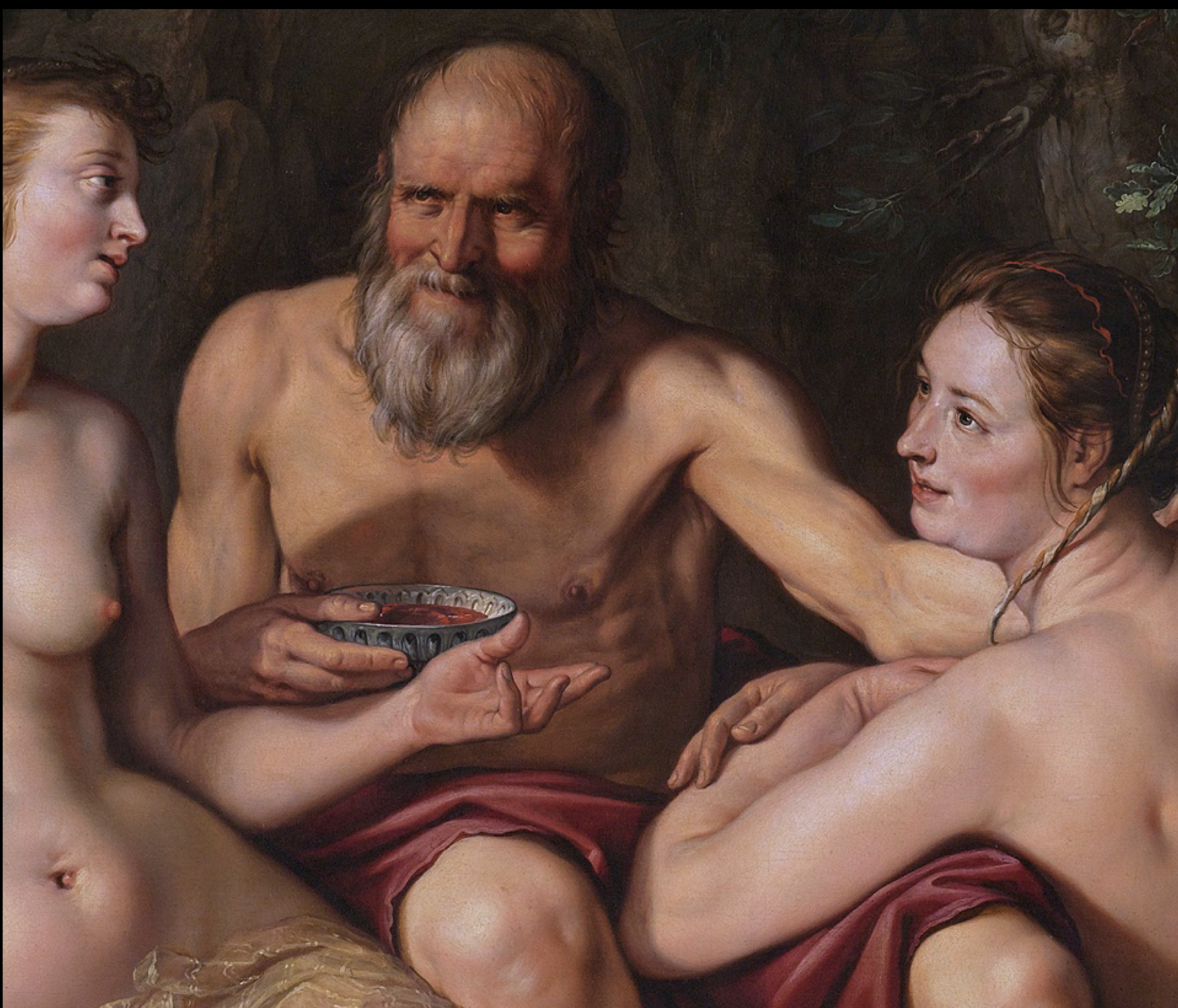
Detail of Goltzius 1616 painting with closeup of Lot and daughters
A look at Goltzius’ and Rubens’ versions shows a nearly naked Lot getting drunk (we so often hear “it was the alcohol that made me do it”) at his daughters’ insistence to break an old taboo – as they had been thoroughly soiled by living in Sodom – as the text of Gen. 19: 31-2 intimates:
“Our father is old and there is no man here to give us children – as is the custom all over the earth. Let’s get our father to drink wine and then lie with him and preserve our family line through our father.”
In the Gen. 19 text a totally drunk Lot seemed unaware – as if that’s an excuse – of either the elder or younger daughter’s having sex with him on successive nights (Gen. 19:35). Goltzius aptly depicts a Lot besotted first with wine and then with lust, and the possibly younger daughter looks at her father with half-lidded eyes of desire, arousal or even post-coital satisfaction.
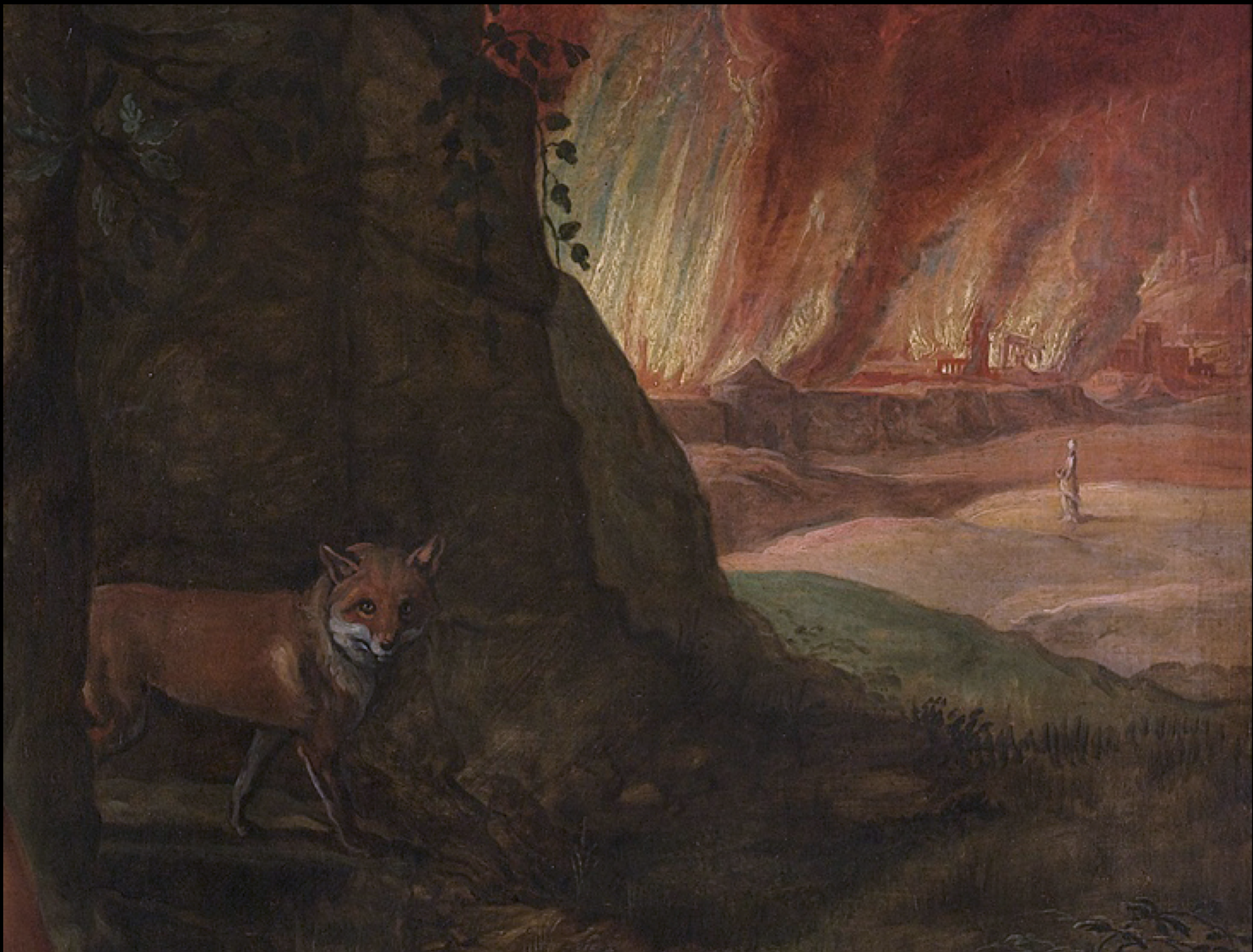
Goltzius’ details with the fox in the middle ground and Lot’s wife becoming a pillar of salt in the background
Equally apropos, on the middle ground right side of the painting, a fox – the symbol of vulpine desire and clever predation – looks out at the viewer. Further in the right background, Lot’s wife transformed into a pillar of salt looks at burning Sodom. In Simone Vouet’s version Lot is clearly fondling a mostly naked daughter’s breast as she sits in his lap. Almost easily missed beside the arm of the daughter on the left, a dark and shadowy corner of Goltzius’ painting shows Lot and daughters lying together and the daughter on the right has her arm nearly between Lot’s legs as van Tuinen’s commentary notes.
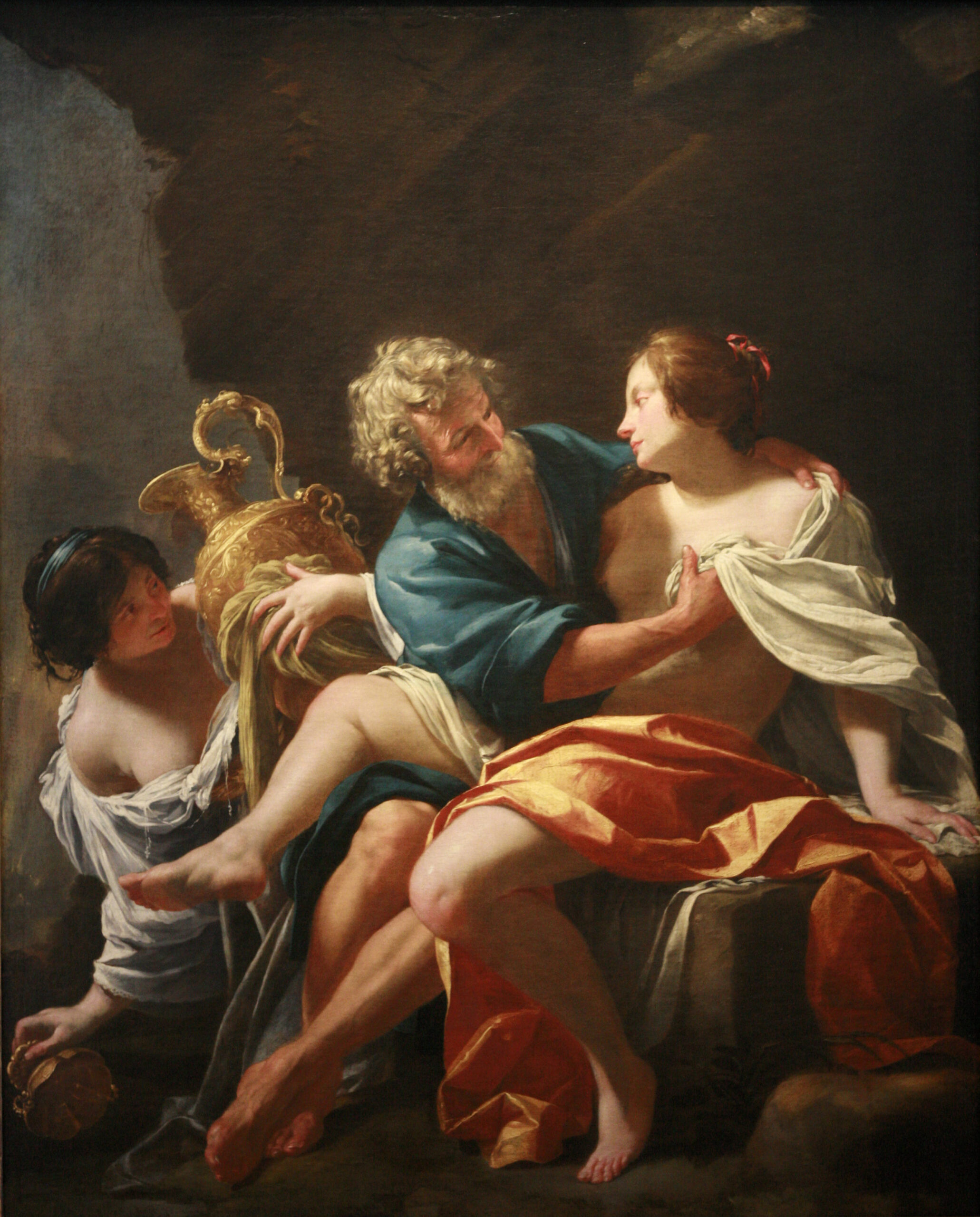
Simone Vouet, Lot and His Daughters, ca.1630, Strasbourg MdBA
The culmination of the sad story beyond the breaking of ancient taboo is even more destructive for Abraham’s descendants in Gen. 19:36-8. The sons engendered by incest and soon born to the pregnant daughters become perennial enemies of Israel: these two sons (and grandsons) will be the pagan tribes of Moab and Ammon who follow Baalism in a form of fertility religion. Incest here is possibly meant to explain the consequences. Of course, the biblical narrative does not commend incest but rather reports its demeaning of higher values by demonstrating the law of unintended consequences. But the paintings included above do not hesitate to show the highly-visible means to the end, however unraveling the outcome will be to civilized society in Lot’s degradation. Thus, the biblical text and the “cheesecake art” instead purport to show why such taboos against incest can be both somehow subtly titillating and yet necessary to invoke a family curse by whatever medium works in text and art as graphic warnings.
Bibliography:
The New Oxford Annotated Bible (New Revised Standard) Oxford University Press, 4th ed. 2010.
Adam Eaker, “Human Drama and Psychological Insight: Rubens’s Lot and His Daughters.” Metropolitan Museum Perspectives, 2017.
Francesca Capelletti, ed. Galleria Borghese Guide. Milan: Electa, 2023.
Dominique Jacquot. Le musée des Beaux-Arts de Strasbourg. Cinq siècles de peinture. Strasbourg: Musées de Strasbourg, 2006, 174–175.
llona van Tuinen. “Lot and His Daughters by Goltzius”. Rijksmuseum NL (https://www.rijksmuseum.nl/en/collection/object/Lot-and-his-Daughters–7b8c9a4a2618f75528c6bcf8b813e9a6).