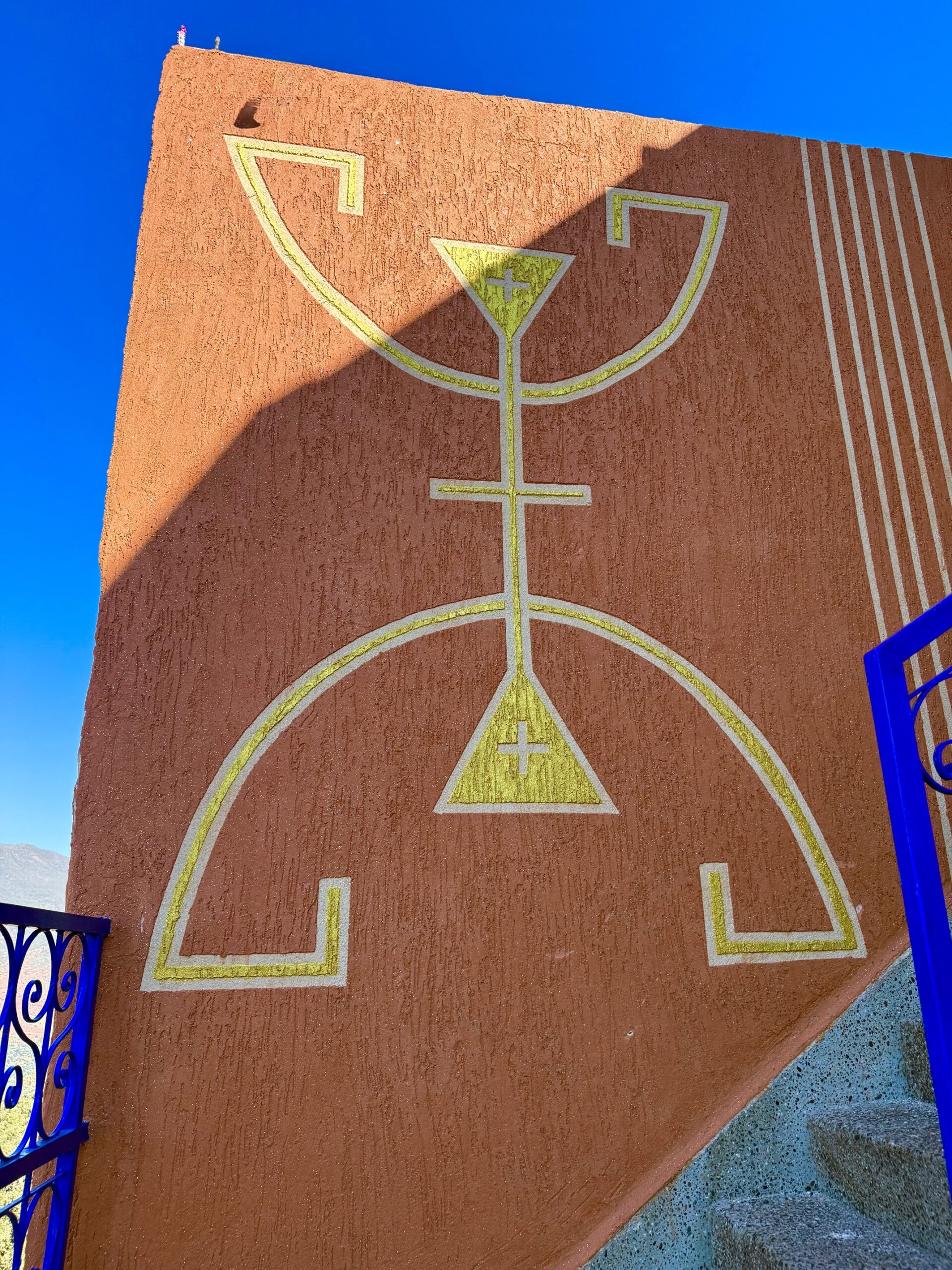
The symbol or sign in Amazigh (Berber) for the Amazigh themselves – Atlas Mtns. above Marrakesh (Photo P. Hunt 2026)
By Youssef Hanha –
The word Amazigh is most often defined as meaning “The Free People”, which is self-referential as their name for themselves. It is likely Amazigh DNA can be traced back into the early Neolithic in North Africa for around 10,000 years. Amazigh people are the indigenous population of North Africa (Maghreb). They inhabit a vast region extending from the Canary Islands to the city of Siwa in Egypt. The name Amazigh is preferred to Berber, a name given by Europeans and too often associated with the word “barbarian”. Because I am Amazigh, I prefer that name to Berber. In Morocco our Amazigh language has been revived officially and can be seen on signs everywhere around the country. The word “Amazigh” usually n ow means “free people,” and it is also associated with nomadic life, reflecting a history of mobility in search of resources before the development of agriculture during the Neolithic period. However, not all Amazigh communities became sedentary, particularly in Morocco, which is largely a semi-arid region.
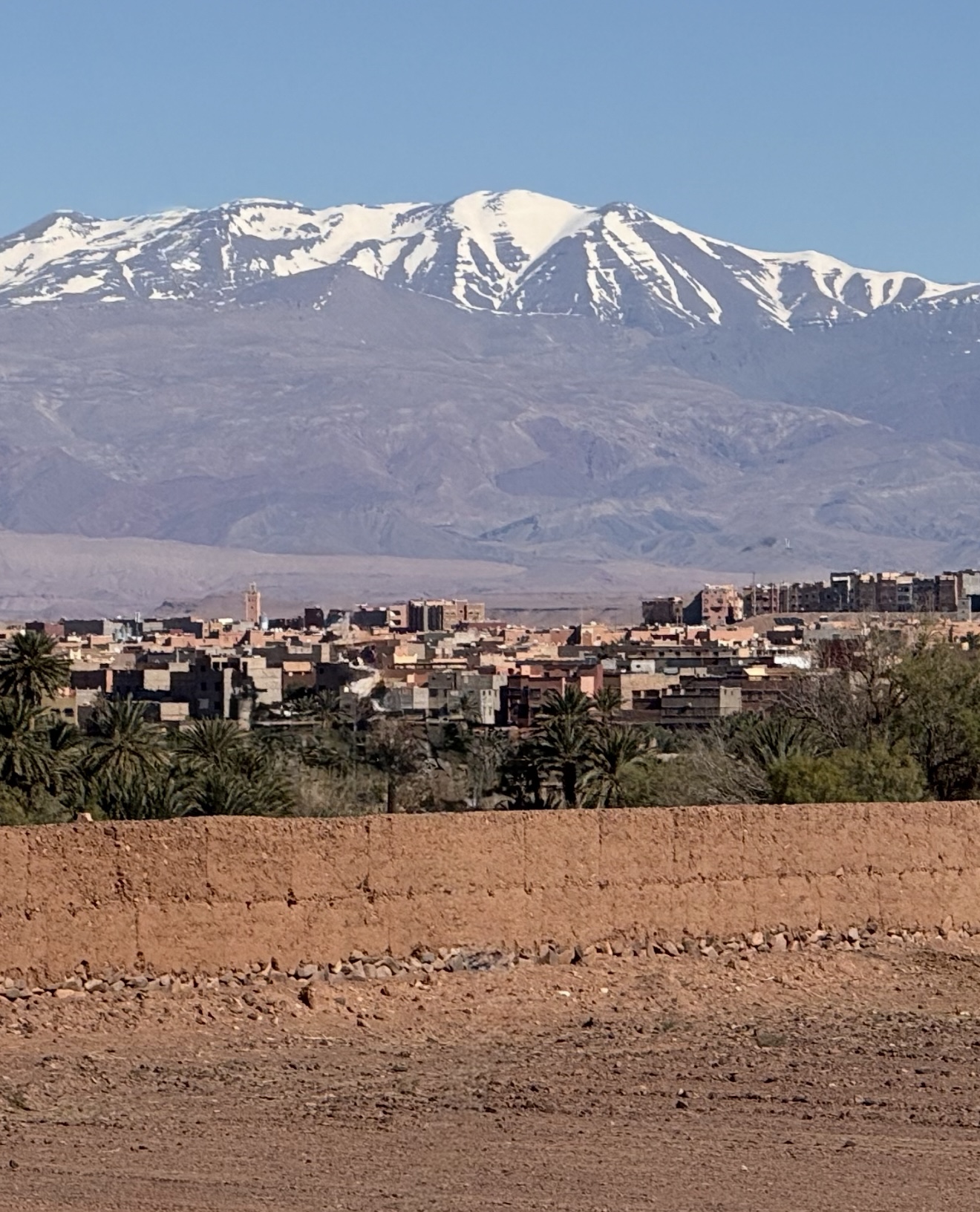
Sahara landscape with Berber-Amazigh villages around Ourzazate (Photo P. Hunt 2026)
Morocco has the highest Amazigh (Berber) population with 14-20 million people out of a total Moroccan population of around 38 million, so around 40-50% of the total Moroccan ethnicity or cultural identity. Algeria has the next highest population of Amazigh with about 7-13 million out of 48 million therefore 15-25% of total Algerian ethnicity or cultural identity. The bulk of the Amazigh population in North Africa live in either non-urban montane zones like the Atlas or the Sahara as well as the Rif montane area along the Mediterranean.
This semi-arid environment has encouraged many groups to maintain a nomadic or semi-nomadic lifestyle, moving in search of pasture and water for their livestock. My own Amazigh village, Tiatfroute, is also part of this brief excursion into the Amazigh.
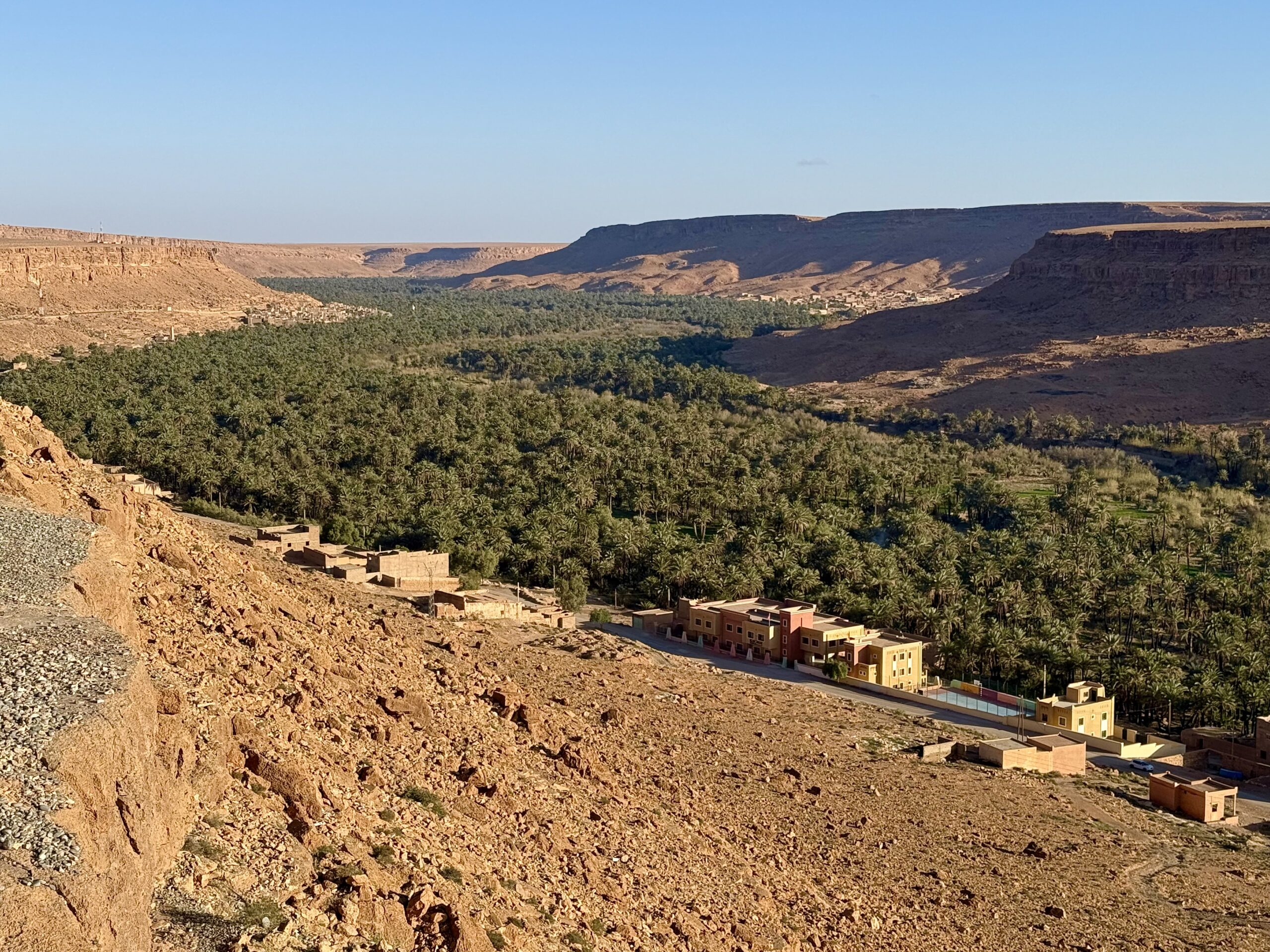
Ziz Oasis – over 80 miles long – descending out of Atlas Mtns. into the Sahara (Photo P. Hunt 2026)
One of the most important landmarks in Morocco is the famous Ziz (River) oasis, with its terminus centered around the Saharan Tifilalet region. Ziz is also the largest contiguous palm oasis in the world, and its name may arguably also be derived from the Tifinagh phoneme representing the Amazigh people as seen below and on its flag. The length of the river and oasis is at least 125 km or over 80 miles starting in the Atlas Mountains and flowing southward, ultimately spreading out and sinking into the Sahara near Rissani – ancient Sijilmasa, founded around 757 CE jointly by Kharijite or Miknasa Amazigh-Berbers and Islamic refugees from Qayrawanat (Tunisia) the trade junction of the gold trade from Timbuktu to the far south.
Regarding the emergence of the ancient Amazigh script we don’t know exactly when it appeared. However, a specific date might be revealed in the future as science and research progress. But according to some dates we were told as children that a reliable date is around 138 BCE – the date inscribed on relief by King Micus and Musib, known in latin sources as “Micipsa” to his father Massinissa (a well-known Numidian Amazigh king who succeeded to the Numidian throne in the tenth year as 148 BCE). The inscription was made and given to his father as a record of witness, and this is what gives us the date. The Amazigh script has this date; it existed in the 2nd century BC, though the writing might be older than that. There’s also a hypothesis that was presented by Gabriel Camps a while ago regarding one of the inscriptions, specifically the man with the inscription, stating that it is located in the High Atlas – at the Yagoure site which contains very rich rock carvings. Gabriel has given the presence of this inscription in a style of ironic engravings that dates back to the Bronze Age. From this hypothesis we can get a glimpse of the writing and inscription at this site which dates back to the 5th century BC. Our Amazigh flag is considered as a symbol of freedom, in the centre of this flag has the famous letter of the Amazigh alphabet (tifinagh) consists of 33 letters. The most famous letter is Z (̣ⵣ), which is also seen as the lead image of this article. This “letter” image is shaped as a person raising his hands to the sky, standing on his feet, as a symbol of rebellion or revolution. Also the color has a meaning, the green symbolizes the agricultural and lush region, we might understand that yellow represents the desert, the blue color considered as Atlantic ocean and Mediterranean sea and the red color in the letter Z (ⵣ) means the blood of martyrs and warriors.
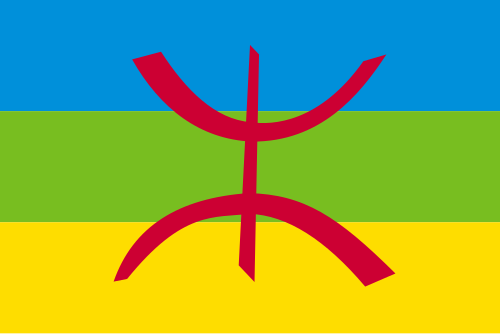
Amazigh Flag (Image in public domain)
Concerning Amazigh warriors and rebels, I will give a glimpse about a rebel from my tribe named Zaid Skounti. Zaid was born around 1890 in a small village called Taskountit, affiliated to Amellagou, his dad Hsain Skounti from the group of Ait Taleb, the clan at Issa Izem. He grew up in a difficult environment and became known for his courage and strong personality. He joined and resisted the French colonial forces between 1918 to 1930 in Tafilalte. He led many battles against the French army and ended up as a leader of the Jebel Badou battle in the year 1933, where he showed great resistance andbecame a symbol of struggle. As historian George Rollan said about this part of Morocco it is a very strong natural fortress, and this is originally sourced from Mohamed El Maazouzi’s published The Moroccan Armed Struggle in Episodes 1900-1935 but usually found only in Moroccan Arabic:
“In 1933, the French intensified their attacks to control the southeastern regions of Morocco. Despite limited resources and harsh conditions, Ouskounti and his companions resisted fiercely. They fought using simple weapons and relied on their knowledge of the land.”
I now wish to focus on the Amazigh tribe of Ait Merghad (sometimes also spelled Marghad or even Merged in transliteration) and their strong connection to the land. The Ait Merghad are part of the Ait Yafelman federation, one of the oldest Amazigh tribal confederations in southeastern Morocco. Living in a harsh mountainous environment, their traditional way of life is based on nomadic livestock herding. They are of Sanhaja origin, one of the major Amazigh groups in North Africa. Historically, their ancestors settled in regions such as Dades, Gheris, and the High Ziz. The Ziz is one of the largest river systems and oasis complexes in North Africa, flowing south from the Atlas Mountains into the northern Sahara.
The name “Ait Merghad” can be broken down into two parts: “Ait,” (or Aït) meaning “people of” or “sons of,” and “Merghad,” which likely refers to fertile or lush land although today the region is rugged and at an elevation of roughly 7000 ft. The tribe is divided into several main groups. The largest groups include Ait Messri and Ait Ouahi. Within Ait Messri, there are subgroups such as Ait Ayoub and Irbibne. Ait Messri itself is further divided into Ait Mhamed and Ait Amer Oumnsour, which includes groups like Ait Boulmane, Ait Hrou, Ait Hami, and Ait Taleb. Another main group is Ait Chrad, which includes Ait Amer Ougahi, Ait Issa Izem, and Ait Oulghhem. These divisions reflect a complex tribal structure rooted in lineage and territory.
I also share about my village, Tafraoute. There are three main accounts regarding the origin of its name. The first, and most widely accepted, suggests that the area was a flat land with ravines. It was historically a neutral ground where tribes such as Ait Atta, Igrouane, and Ait Yafelman (including Ait Merghad, Ait Haddidou, and Ait Izdeg) would come to establish truces and peace agreements. In Amazigh, “Afra” refers to reconciliation or peace, so the name “Tlat n Afra” could mean “a place of reconciliation.” Over time, this evolved into “Tafraoute,” a place where anyone entering was safe.
The second account suggests that the area was used for horse races, known as “Tlat n Tafraoute.” This idea is supported by the nearby place called “Tizin n Imnain,” meaning “the pass of the riders,” now known as Goulmima. The third account relates the name to water management. “Tafraoute” (ⵜⴰⴼⵔⴰⵡⵜ in Tachelhit Amazigh ) may refer to a cistern (Tanoudfi) used to collect rainwater. There is also a place called “Tafroin,” which still exists today in the Souss region. According to this narrative, water collection systems played an important role in the naming of the area.
Historically, the region was inhabited by other nomadic tribes before the arrival of the Ait Merghad, particularly the Imghrane and Igrouane. Evidence of their presence can still be found in place names in the surrounding mountains, such as “Ketlat n Aboush n Talmkit,” “Akni,” and “Izri n Toujilt.” These tribes had conflicts with Ait Merghad during the nomadic period, before eventually migrating toward regions such as Rich, Midelt, and later Meknes.
The Igrouane were Amazigh tribes who once settled in areas like Aqa Wazou and Daou Ikhendji before migrating due to drought and harsh conditions. Their presence is still remembered through ancient burial sites. The Imghrane, on the other hand, are known for their nomadic lifestyle between southeastern Morocco and the Souss region, and today they are mainly found around Ouarzazate and El Kelaat Mgouna.
One ancient Amazigh queen perhaps also stands out for good reason. Al-Kahina is known to have united various Amazigh tribes under her leadership to fight against the Muslim conquest of the Maghreb, leading the indigenous North African defense of the region then known as Numidia. She fought in multiple battles, notably defeating Umayyad forces in the Battle of Meskiana. Afterwards, she became the uncontested ruler of the whole Maghreb region,and remained so until being decisively defeated at the Battle of El Jem.
There are various accounts of the circumstances surrounding her death, but she is thought to have died in modern-day Algeria towards the end of the 7th century, or early-8th century. For five years Al-Kahina ruled a sovereign Berber state from the Aurès Mountains to the oasis of Ghadames. She is considered one of the most famous figures in the history of the Berber resistance to the Arab conquest. Her legacy has been retold through oral tradition since her lifetime. There are various written accounts of her from precolonial and postcolonial perspectives.
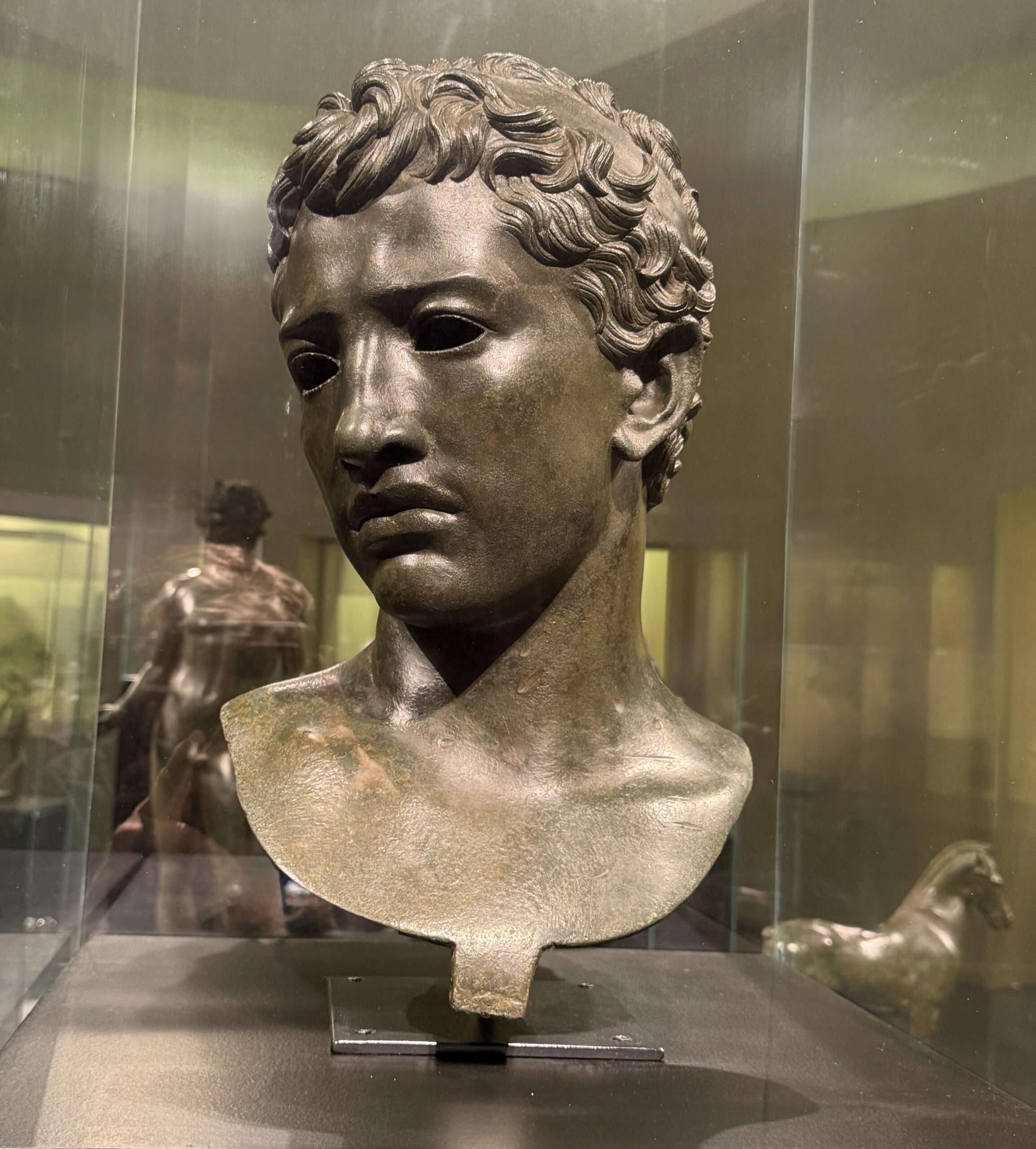
Bronze Early 1st c. CE Sculpture bust of King Juba II in Rabat Archaeology Museum (Photo P. Hunt 2026)
Perhaps the most famous Amazigh king in antiquity was Juba II (ca. 48 BCE-23 CE) who ruled as a client king of the Numidians from his city Volubilis (Morocco) under the Romans in the Augustan Age. He was said by both Cicero and Pliny to be one of the most brilliant minds in the Roman World. As a botanist, he was the first scholar to study the semi-arid plants of the Euphorbia family. ironically, he claimed to be descended partly from the Barcid clan and even Hannibal himself.
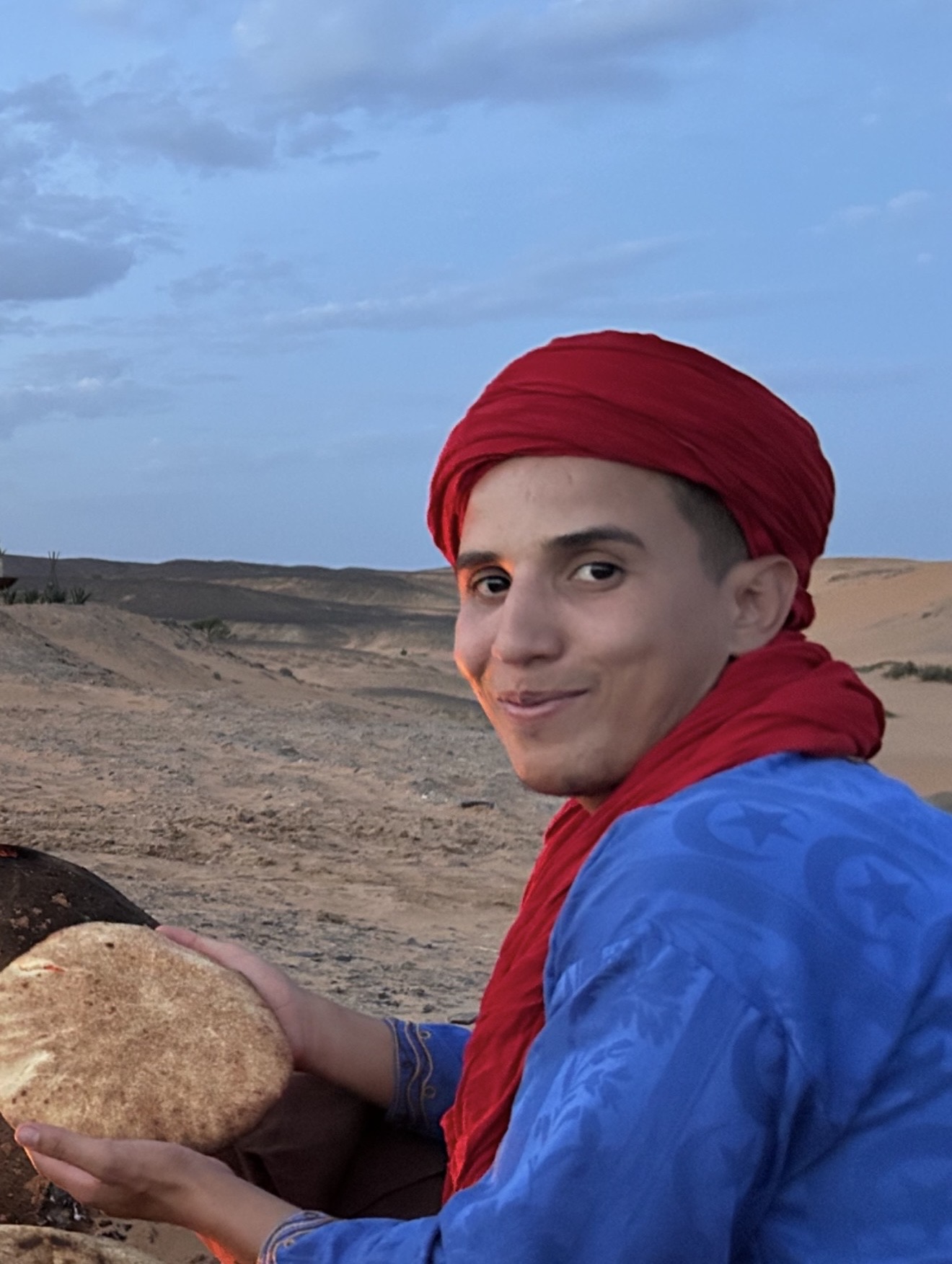
The resilient Amazigh have been increasingly enabled and empowered by the King of Morocco Mohammed VI (reigning since 1999) and the Moroccan government to be equal to those who arrived in North Africa from Arabian culture, ethnicity and language in the 8th century CE, so much so that the Amazigh-Berber language is now on equal footing with Arabic and French.