By Sara Olsen –
The story of Persian culture begins in the dawn of time with firm roots in the domestication of the horse. Culture evolved from nomadic to a settled agricultural tradition largely with the help of a domesticated horse. From the time of the horse, there is evidence that carts or chariots and horse tack evolved which increased the ability of the Persians to occupy a larger territory through warfare. The importance and value of the horse in culture is illustrated by poetry, artifacts, blankets and textiles as well as decorative art. In the Sassanid period ca. 4th c CE, many gilded silver artifacts of horses can be found, for example in the image below from Boston MFA.
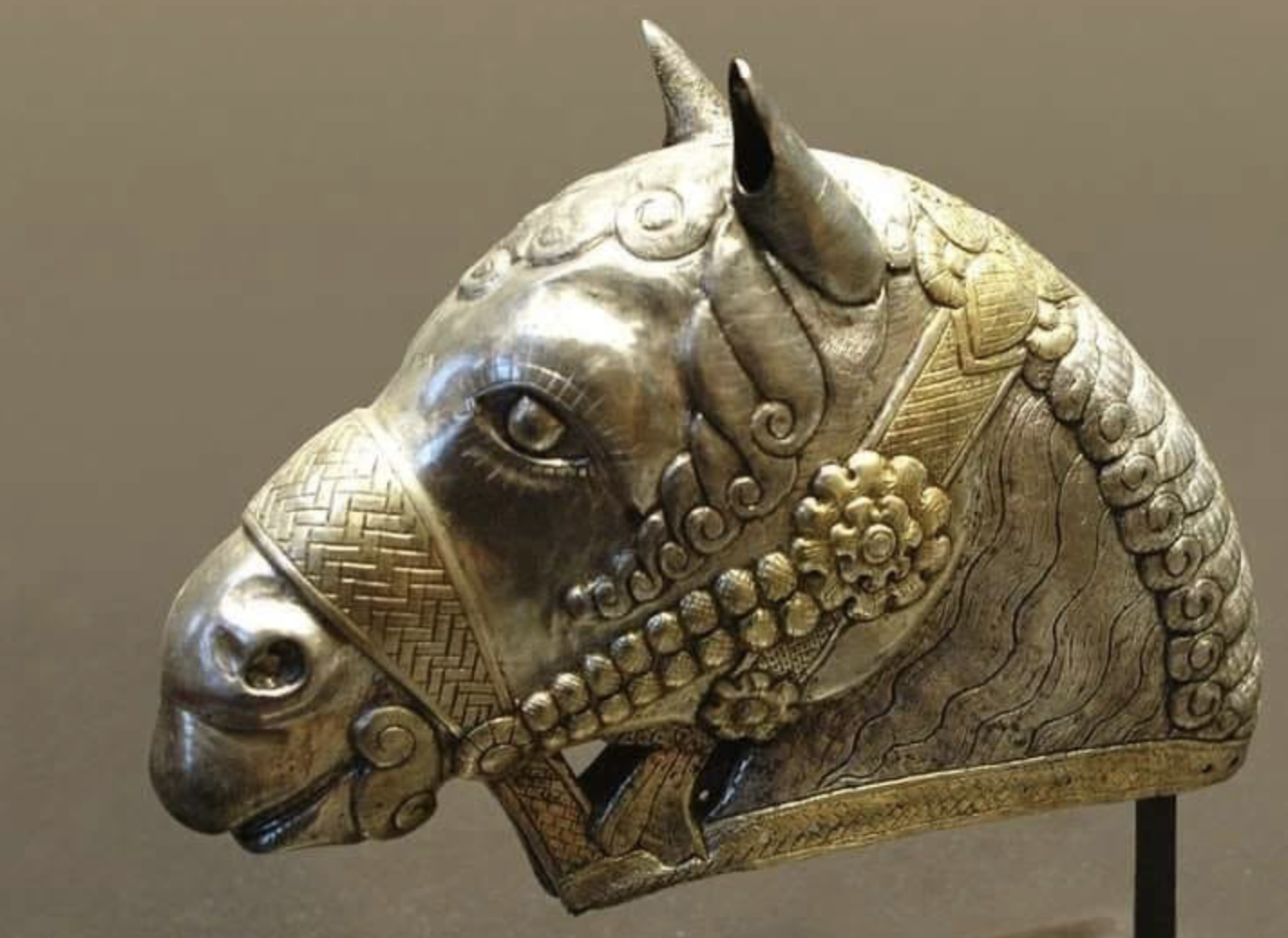
Sassanid Gilded Silver horse head, ca 4th c. CE, Boston MFA (photo courtesy of Ulaisa Karimi, 2024)
And, even today the horse culture magnifies the value assessed to ownership of prized animals. Myths and legends surround Persian history, and nestled inside is the story of the horse. Even in the Achaemenid Empire of Darius (ca. 500 BCE), the legend was that Darius and his groom succeeded in having Darius’ stallion neigh first at dawn when the competition to be king was to fulfill an old Persian prophesy that whoever’s horse neighed first at the dawn’s rising sun would be king: the groom had placed a rag with a mare’s scent in front of the nose of Darius’ stallion at just the right moment.
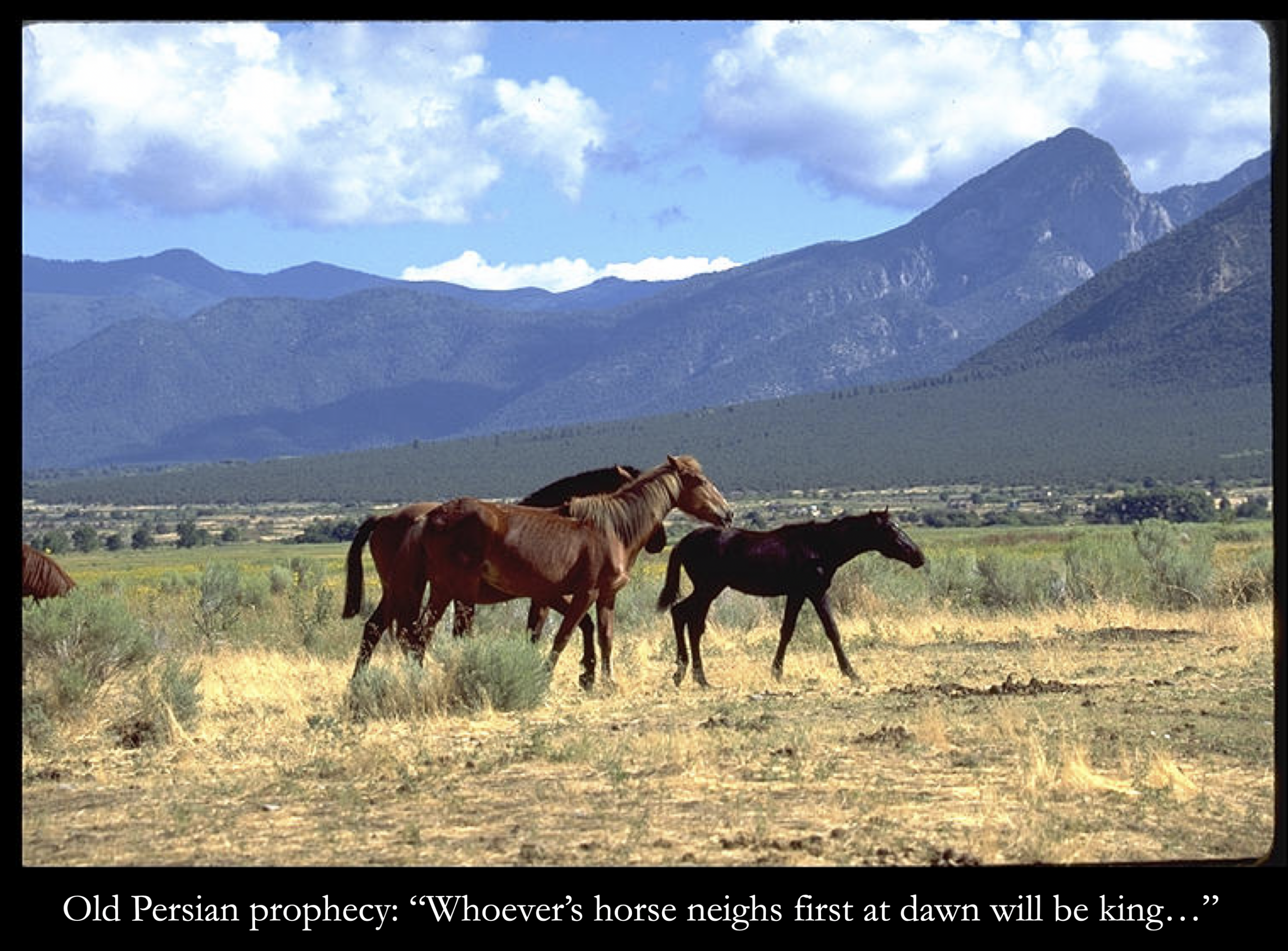
Where did the horse originate? Depending on how far back the origin is traced from the Greek names of Eohippus or genus Hyracotherium, sometimes referred to the “Dawn Horse”, during the Eocene epoch wherein they were odd toed, 4 in front and 3 in back ungulates, to when they appeared in North America around 1.1 to 1.2 million years ago (Captivating History, 4), their arrival during the Pleistocene epoch appears to have been when many horses crossed the Bering land bridge into Eurasia spreading their range to Northern Siberia and Western Europe. Meanwhile, the early type of horse declined in the Americas around 12,000 years ago, maybe because of hunting or climate change. The Eurasian steppe featured wild ancestors of modern horses, extinct Tarpan or Equus ferus (Captivating History, 3) and the endangered Przewalski horse of Mongolia (Equus ferus przewalski), which survived in the harsh environments. Today’s horses have a slight variation of what existed in ancient wild horses. Modern domesticated horses are descended from a genetic variety DOM2 (Wetenhall, Foreward, 18). This genetic variation made horses easier to ride in the Pontic-Caspian steppes with favorable mutations such as ease of back pain and greater endurance as well as less fear and anxiety. These mutations were favored across Anatolia, the Near East, Central Asia and China. (Wetenhall: Foreward,19). What is known of the Caspian horse which lived in the Zagros Mountains around 3400 BCE is thought to have been perhaps the earliest breed domesticated, as modern excavation remains have established with a Caspian horse skeletal find (ca. 3400 BCE) from Gohar Tappeh in NE Iran’s Mazandaran Province (CAIS [Mahfporuzi], 2011; also see Firouz, 1972).
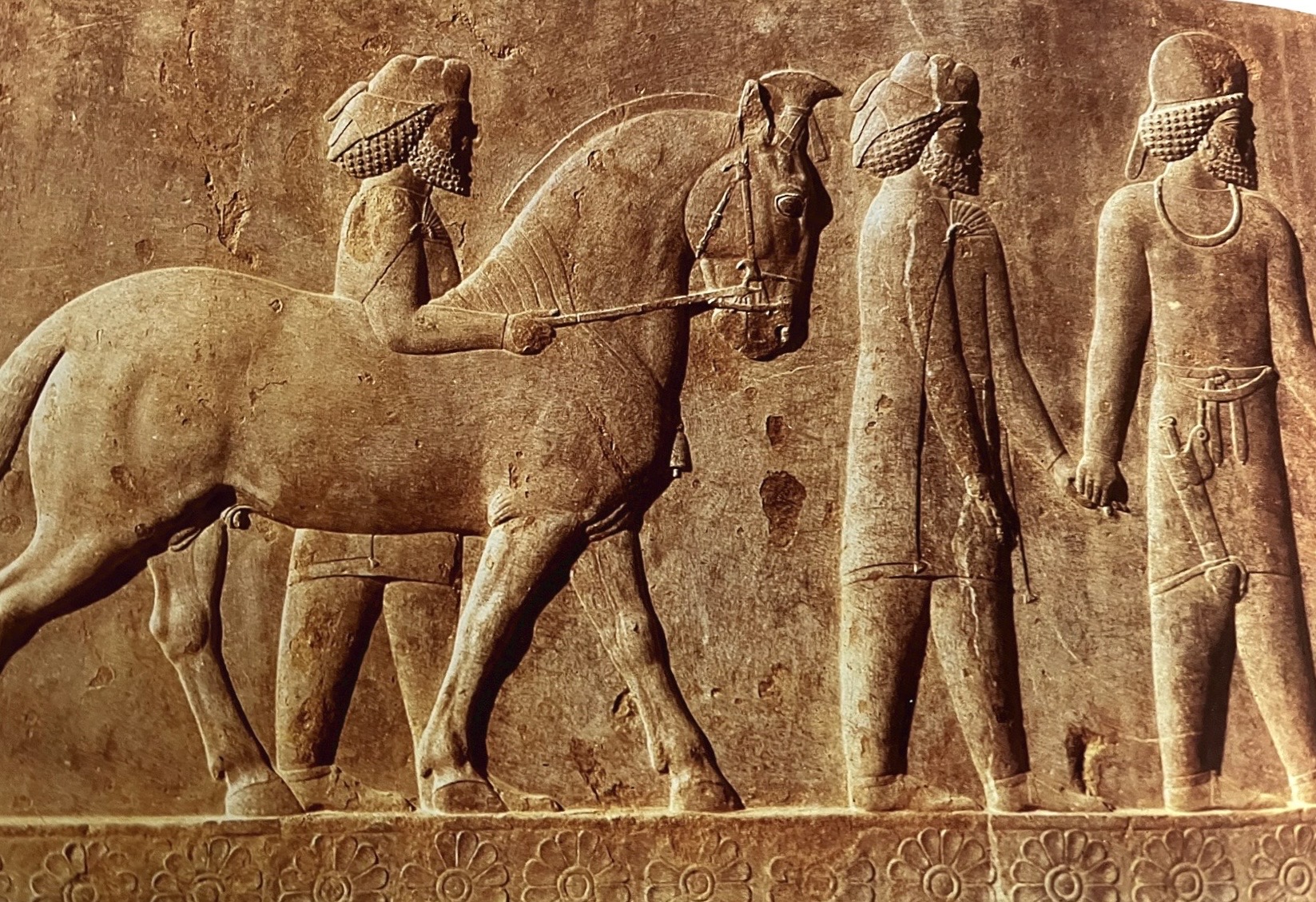
Horses being led are also depicted in the Apadana Reliefs from Persepolis (image in public domain)
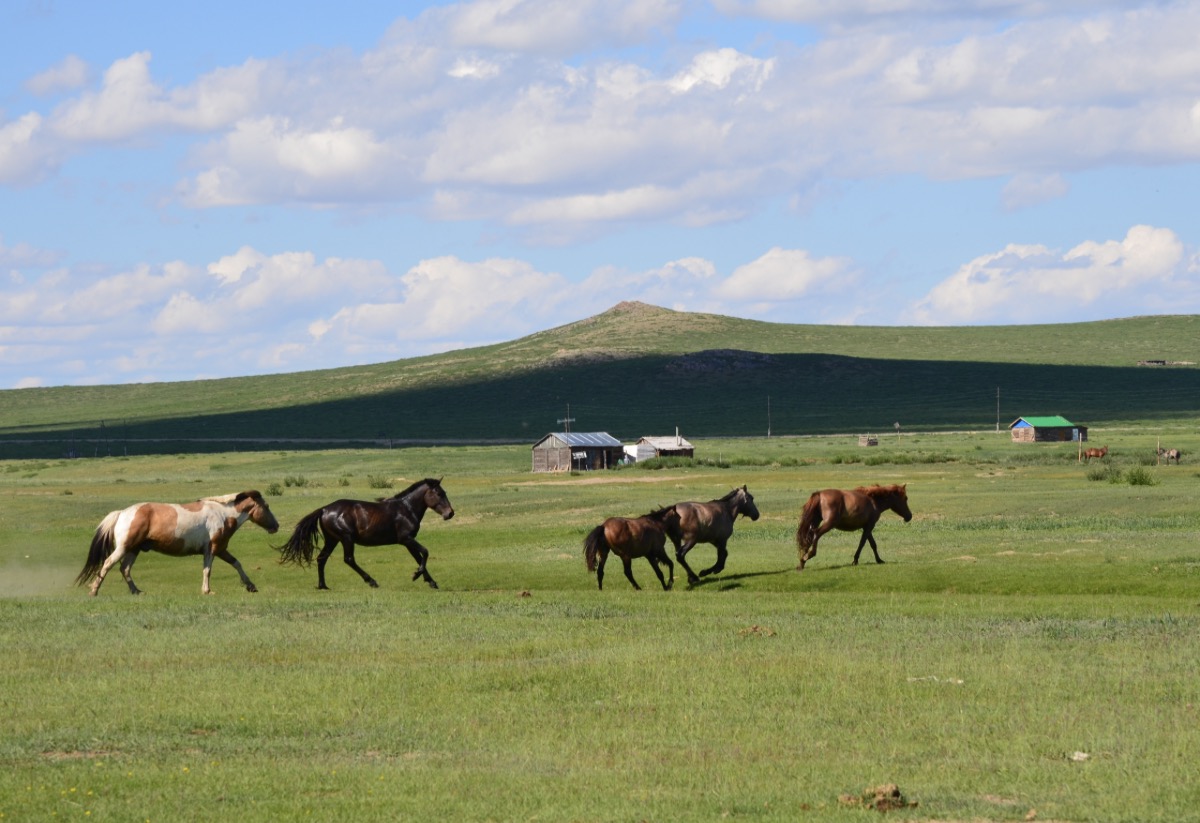
Early depictions of horses in Paleolithic cave paintings discovered in Europe – for example at Chauvet, Lascaux and Altamira – indicate early horses were worthy of depiction and may have been hunted for food as a source of meat. Horses were primarily grazing animals which affected the ecosystem. This would have made it necessary for nomads/herders searching for their food source to either domesticate the horse and/or move from place to place following the grazing horse as it was searching for grazing lands. The Eurasian steppe was an area where horses could survive if they had enough food.
The Iranian or Persian peninsula is surrounded by mountains with plateaus and deserts. Persia is in a region called Paruash, known as Pars or Fars. (Axworthy, 4). The name of Persia may even derive from or be related to a word used for horseman asabāra in Old Persian, which hints at the importance of the horse in Persian culture. The settled populations were small and had limited water because the mountains blocked the rain. They were “the arid-isolatic society” (Katouzian, 4) who at some point started to grow crops using irrigation sources from the mountains or streams. Meanwhile, the nomadic peoples moved their herds often to fresh pasture lands for grazing, necessary because the grazing horses used their incisor teeth to bite off the stocks of grasses, making it necessary to move often to rotate the grazing lands. When the domestication of seeds of wheat and barley was innovated, this cultivation of grasses made it possible for the small settlements to begin to domesticate grazing animals, horses for one. (Hunt, lecture notes Archaeology 118). As more people lived in these settlements, the competition grew for more grazing lands. Horses became a part of a settled life of agriculture both for food and later to be used in transport or for acquiring more land. The geographic conditions and irrigation of lands made the earliest domestication of a horse, perhaps the small Caspian pony or small horse, a valuable asset for conquering more land and the expansion of the Persian empire around 3400 BCE.
When horses and humans began to trust one another and the relationship went beyond merely using the horse for meat and the mares for their milk, the ability to have control over horses developed. Because of the nature of a horse’s teeth, the small gap in the teeth between the incisors and the molars allowed for a space that later was used to place a bit to control. Early on, the bit was merely a piece of perhaps rawhide, held in the hands of the human for control. Eventually, when the horses were ridden, the rider would control riding bareback with his or her legs with no stirrups. When the mares were used for milking, it was necessary to have their foals nearby, and the mares slightly tamed and selected to be good milk suppliers. (Interestingly that even today, the traditional technique in Mongolia for Airag or fermented mare’s milk has UNESCO recognition for “traditional technique of making Airag in Khokhuut and its associated customs”. It is on the representative list of the “Intangible Cultural Heritage of Humanity”. UNESCO Travel Mongolia, “Mongolia”),
With ideal conditions for horses to graze, semi nomadic hunters and herders could rely on a source of food. Increasing population meant it was clear that the domestication of horses to use in searching for food and water and to cover vast distances was desirable. Selective breeding to reduce anxiety and to strengthen musculoskeletal structure for riding and to carry loads became necessary. Later, these improvements to riding horses helped increase the vastness of the Persian empire through more effective warfare for land gains. The value placed on good horses began to be exhibited in poetry, art, and in status.
The Steppe peoples of the Iron Age (ca. 1st millennium BCE) managed to convert their carts to lighter weight chariots, using bronze rims and fittings instead of heavier materials. Horses, domesticated, could be harnessed to carts that moved faster, and the two horse hitch appeared to reduce the horses’ trauma for being hitched to a cart. (Chaffetz,26). The vehicle could be used for hunting with a bowman standing upright. Soon, these carts would be used for combat. Chariots, however, required development of additional horse tack including bits and cheek pieces and buckles to hold the reins. Horses, like the Caspian might have been too small to hold heavily armed riders, but a team of horses could easily pull chariots (Chaffetz, 27). Part of the new horse equipment was a third rein attached to the bridle’s noseband that gave a greater precision when turning (Taylor, 135). The Persians became a horse culture and were recognized as such.
Herodotus, later in the Fifth Century, said of the Persians and how they viewed their sons and horses:
“From the age of Five to the age of Twenty, They teach their sons just three things: To ride Horses, to shoot the Bow, and to Speak the Truth”
The Histories, 1.136
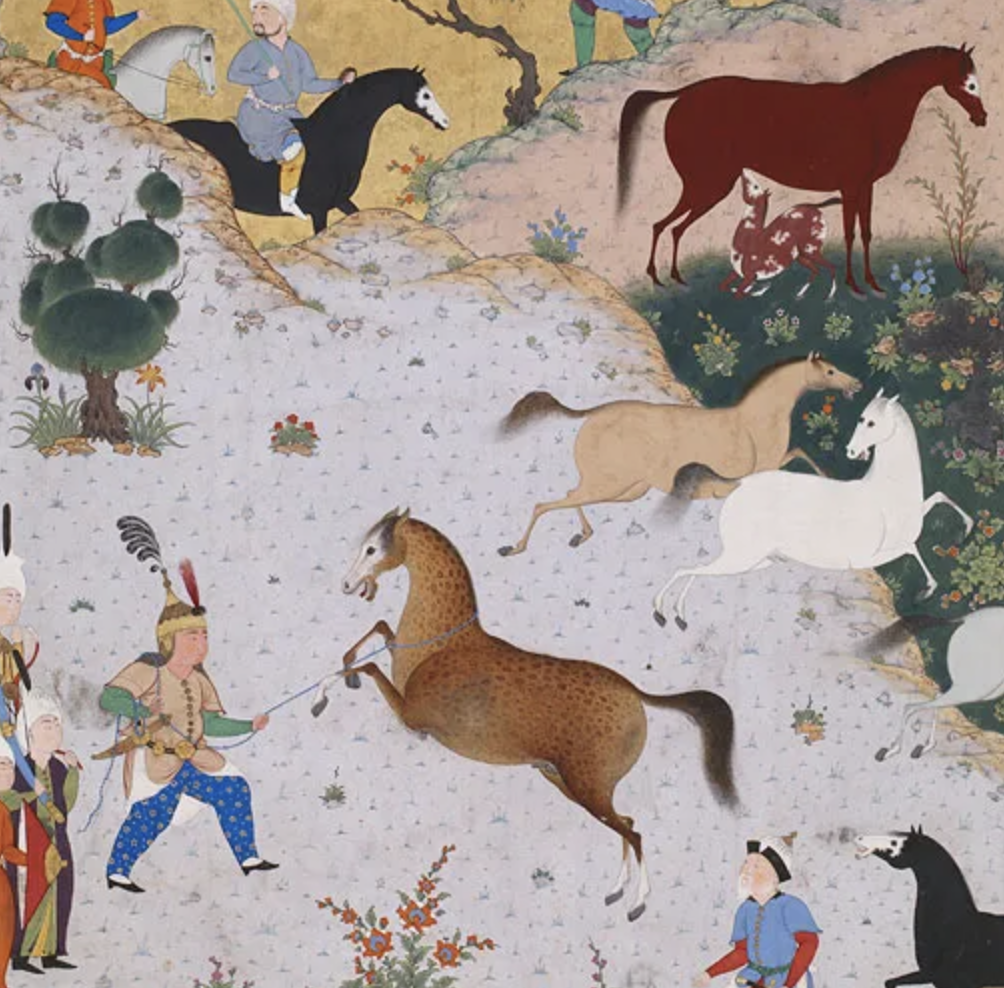
Firdawsi’s Shahnameh. Attr. to Mir Musavvir. Rustam Lassoing Rakhsh, Tabriz, ca 1525 (courtesy of Smithsonian Asian Collection)
Rulers of other kingdoms sought out steppe people for their knowledge of chariots and horses. The Persian culture spread for the next 3000 years (Chaffetz, 31). Tombs with chariot burials traced a wide path especially throughout the Bronze Age. Between 1800 BCE and 1200 BCE, new developments in tack and weapons and selective breeding of horses led to heavier horses with an increase in height and, again, according to Herodotus, the custom of giving and receiving gifts of horses was accepted. And, The Persian rulers drank water from the river Huvaspa, of “Good Horses”.(Chaffetz,p.40 and 53). Mounted archers evolved especially among the Scythians. Horse breeders marked the beginning of empires including the Persian. The national epic, “Shahnameh” and the symbolism of good and evil in court ceremonies was expressed through horses. The Kings rode white horses and white horses were sacrificed on solemn occasions (Chaffetz,p.53). From Ferdowsi’s Shahnameh below:
Shahnameh, The Persian Book of Kings”, 131 to 133
‘Rostam and his horse Rakhsh’ When first seeing Rakhsh, His Body was a wonder to behold, Like saffron petals mettled red and gold”
And continuing..
“Hard pressed in wars or on the battlefield, With God to aid me, I shall never yield. I need to capture with my noose a horse Of mountain size and weight, of mammoth force, I need a crag-like-mace if I’m to stand Against Turan, defending Persia’s land.”
Zal, the father, satisfied that his son, Rostam, would be safe in battle with his horse Rakhsh, and moved by the words of his son
“Rakhsh and his noble rider seem to bring To Zal’s reviving heart the joy of spring.”
By 535 BCE, the Persian Empire of Cyrus the Great was the world’s largest empire to date. (Hunt, 2026) thanks partly to the development of the horse culture. Cyrus established three stud farms for breeding Persian horses, emphasizing the importance of established breeds or selective breeding; horses strong and powerful enough to hold the heavily armored warriors. Persepolis, although attributed to Darius I, may have been also part of Cyrus the Great’s design. On bas-reliefs, along the east stairway wall of the great central hall, are images of the powerful Persian cavalry horses, or Nisaean, inscribed there 2500 years ago (Chaffetz, 54). The frieze shows tributes to the King from the peoples of the kingdom, and the horse in the frieze appears to be one that would appeal to a monarch. The horse, although small, looks to be a powerful, prized chariot horse. (Pickeral, 30).
Under Cyrus leadership, a postal relay system developed. Horses were ridden between planted posts and and exchanged for fresh horses at each post. This method linked distant reaches of the Empire…much like pony express or even the “post” office today. Horses made it possible to govern the Persian Empire as messages or commands could be sent from the capital throughout the kingdom by rider and horse.
Horse domestication and riding touched early complex cultures especially during the first Millennium BCE. Ancient life included accomplished farmers with settled lives to nomads in seasonal camps who used the horses for food, transport and warfare. Mounted riding brought peoples together across travel routes and trade including the silk road (or horse road) in spite of all the new language groups and new ideas. At the heart was the horse nation of inner Asia (Taylor, 30). Grave goods give a peak of these cultures who came together. Scrapes of woven fabrics and items of mounted combat such as bows, arrows, horse tack have been interred along with gilded bridles and headdresses (Taylor, 133). Selective breeding of horses added to the value of the horse and became part of the Early Persian Culture. Value and status illustrated by the significance of gifts of horses along with tack, had a political and diplomatic purpose as well as was a symbol of prestige and ceremony. The tack usually was made of costly materials and was skillfully crafted (Adorning the Horse, 139). Value placed on Persian horses also manifests itself in the beautiful textiles that adorned the prize horses. The gifting of horses was a fundamental activity for political purposes, celebrations or rewards. The accompanied tack and precious textiles and often their grooms give indictions of how special horses were revered (Adorning the Horse, 141). One of the earliest examples of textiles of the horse culture is a woven equestrian textile called the Pazyryk carpet found in Siberia “possibly woven in Ancient Persia by special order” dating to 500 BCE for Scythian nobility (Thomas Cole, Brick Freedman Collection, 67)
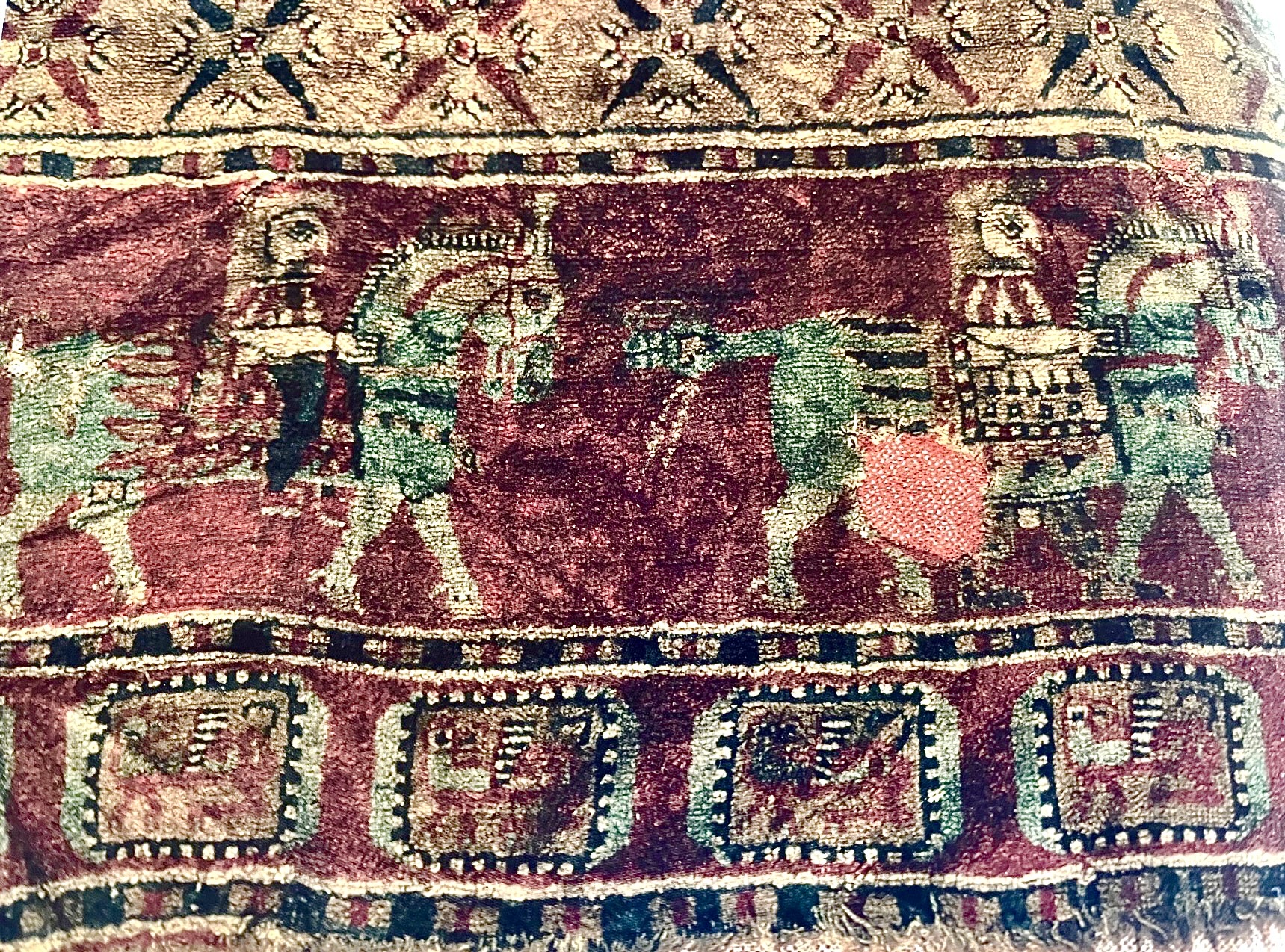
Horses were valued by the Scythians too, as seen in the Pazyryk Carpet (Hermitage Museum) and in the Altai Mountains with the Pazyryk Mound where the skeletal of 54 horses were buried as sacrifices, some with ornate tackle. The Scythians had by now set the standard for burial practices (Harl, 63, 72), already being skilled horsemen archers who at times even terrified the Persians.
Conclusion
And so the horse culture begins, not just in the Persian Empire but also across other cultures of the Earth. The horse has left its hoof print in agriculture, transportation and innovation, warfare, poetry, art, textiles and sport. Their value is expressed in the prestige of ownership through gifts made in life as well as in the honoring of significant deaths. Horses have been part of the triumph as well as the downfall of many different cultures throughout the world.
In the ancient world for millennia it is clear that poetry, art, warfare, and expansion of the Persian Empire all can be attributed in part to the influence of the horse in the culture of Early Persia.
Bibliography
Abdulrahim, Raja. “Atop Horses, Archers Aim for Glory and a Link to Ages Past [Nomad Games]”. New York Times. Oct 26, 2026.
Axworthy, Michael. A History of Iran Empire of the Mind. Basic Books / Perseus Books, New York, 2016.
CAIS (Circle of Ancient Iranian Studies). “Oldest Remains of Caspian Horse Discovered in North of Iran.” CAIS-SOAS. April 29, 2011 (https://www.cais-soas.com/News/2011/april2011/29-04.htm)
“Captivating History, The Domestication of Horses”. 2023.
Captivating History, The Persian Empire. 2018 (https://www.amazon.com/dp/B0FB3HR4VX?lv=shuf&channelId=500&plpRedirect=mhFallback).
Chaffetz, David. Raiders, Rulers and Traders, The Horse and the Rise of Empires. W.W. Norton and Company. New York, 2024.
Ferdowsi, Abolqasem. Shahnameh”, The Persian Book of Kings. Dick Davis, tr. Penguin Random House, LLC. New York, 2016.
Firouz, Louise. The Caspian Miniature Horse of Iran. Field Research Studies, Florida, 1972.
Harl, Kenneth. “Empires of the Steppes”, A History of the Nomadic Tribes who Shaped Civilization. Hanover Square Press. Toronto, Ontario, Canada. 2023.
Hunt, Patrick. Ancient Persia ARC 118 Lecture, Stanford University, Stanford CA. 2026; also see Rezaeian, Farzi. 5000 Years of Iranian Engineering, Sunrise Books and Media, 2015.
Katouzian, Homa, The Persians, Ancient, Mediaeval and Modern Iran. Yale University Press, New Haven, Connecticut. 2010.
Khayyam, Omar. The Rubaiyat of Omar Khayyam. Edward Fitzgerald, tr. 2019.
Larson, Shane. The Scythians, The Horse Archers who Terrified Greece and Persia, Peak Grizzly Publishing, SF Bay Area, 2026.
Pickeral, Tamsin. The Horse: 30,000 Years of The Horse in Art. Merrell. London, England. 2006.
Herodotus, The Landmark Herodotus, the Histories. Robert B. Strassler, ed. Vintage Books (Penguin Random House) New York, New York. 2009, esp. 1.136.
Taylor, William. Hoofbeats, How Horses Shaped Human History. University of California Press, Berkeley, CA. 2024.
UNESCO: Intangible Cultural Heritage of Humanity”. UNESCO Travel Mongolia, “Mongolia” (https://ich.unesco.org/en/state/mongolia-MN).
Wetenhall, John. Adorning the Horse, From the Brick Freedman Collection, Thomas Cole, The George Washington University Museum and the Textile Museum, Washington, DC.
Note : Today the competition of mounted archers in The World Nomad Games, an international tournament, is rooted in ancient warfare and ethnosports. Competing archers on a galloping horse aim and shoot arrows at targets. These games are reminders of ancient warfare on horseback not unlike early Persian warfare. (Abdulrahim, NY Times, 10/26/26).