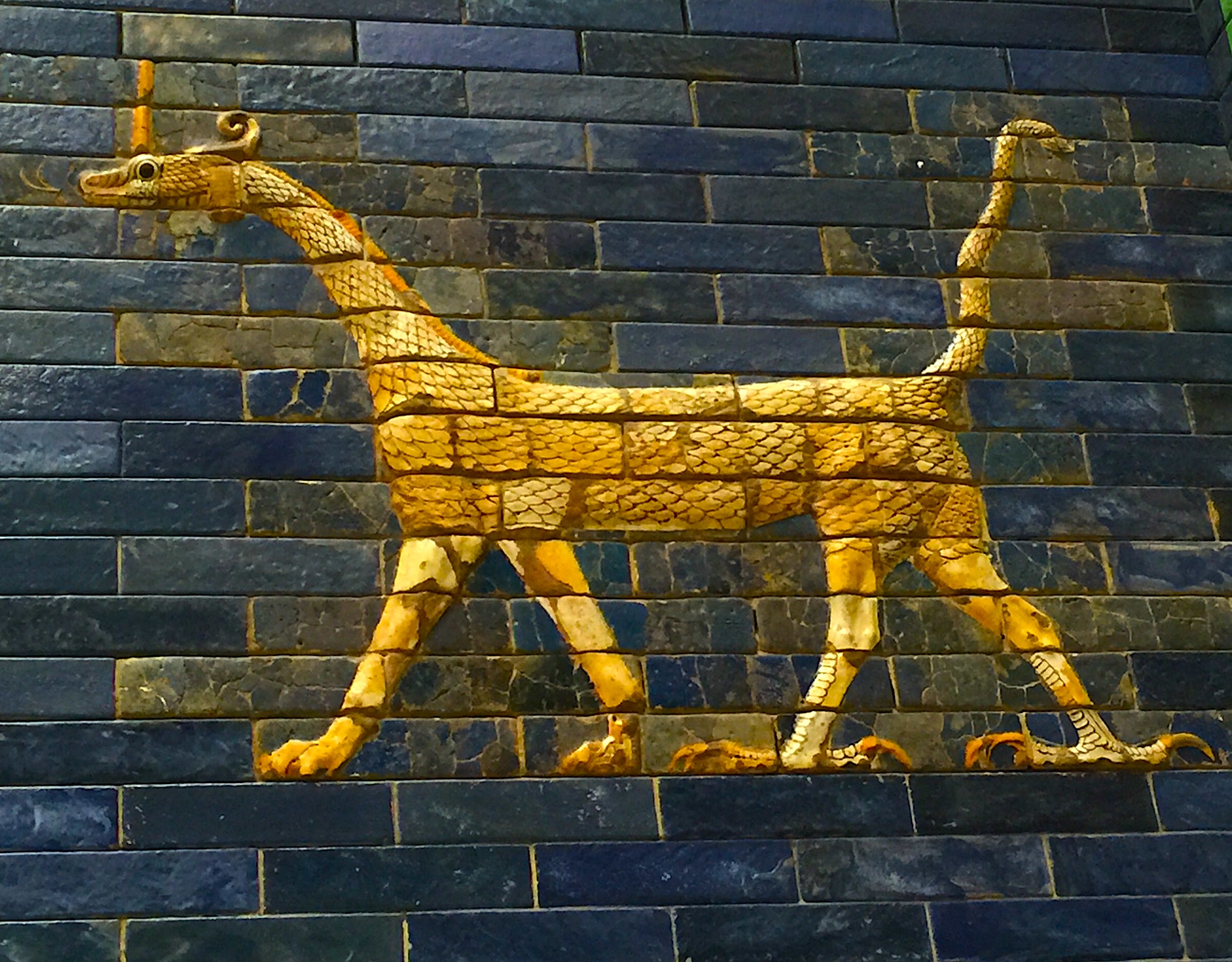
Ishtar Gate mušḫuššu frieze (Photo courtesy of P. Hunt, 2016)
By Cheryl Solis –
Aller Anfang ist heiter; die Schwelle ist der Platz der Erwartung. “Every beginning is joyful; the threshold is the place of expectation.” Johann Wolfgang von Goethe,
Wilhelm Meister’s Apprenticeship, ca. 1796
Many have marveled at the Ishtar Gate. Modern visitors to the Pergamon (Vorderasiatisches) Museum in Berlin, Germany, have seen the partially reconstructed edifice that was a fixture of ancient Babylonian life. Details of its construction, height, size, and materials have been analyzed and the context of its development interpreted. Even the emblems adorning the brick faces have had extensive material analysis and interpretation. This paper focuses on one of these images, that of the mušḫuššu dragon and argues that it possesses a unique quality for a protective emblem. Unlike many other hybrid figures, the mušḫuššu dragon strongly suggests an emphasis on the chthonic (earthly or underworld power from the Greek word chthōn as “earth”) in the configuration of its form.
The Ishtar Gate of Babylon
The mušḫuššu figure appears on many Babylonian and other earlier Mesopotamian artifacts such as statues and cylinder seals (Black and Green 166). However, it is the images that appear on the Ishtar Gate that give us a visual reference large enough to really show the different proportions of the creature. Its appearance on the gate is also significant as it seems to be the only hybrid depicted on the gate. Some of the same remains are also seen in the Baghdad Museum in Iraq, itself not far north – about 85 km – of ancient Babylon near Al-Hillah.
Although not precisely measured, the mušḫuššu figure on the Ishtar Gate, from photographic images, can be estimated to be approximately six feet in size. As shown in Figure 1, below, gives us a comparative gauge to measure the length of this mušḫuššu figure around 5 feet. Given that width, a rough estimate of its proportions are approximately 50 to 60% snake-like body, head and tail, with 10 to 25% of its form represented by lion’s forelegs and 10-25% of its form as raptor’s hindlegs. The mušḫuššu also sports a small cap of horns and a scorpion’s stinger at its tail tip.
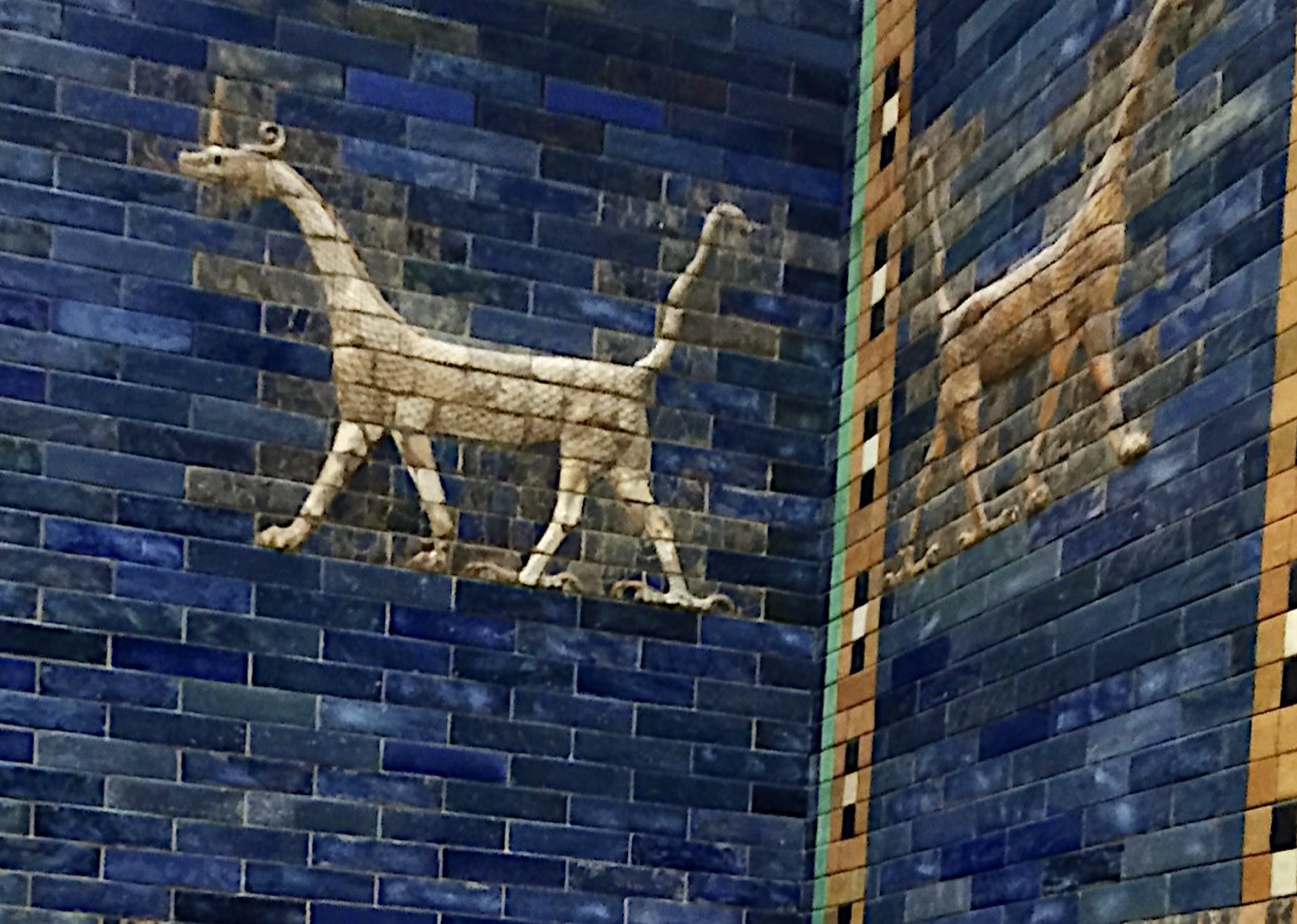
Figure 1. Mušhuššu: Glazed ceramic tile friezes of Nebuchadnezzar II’s Ishtar Gate, Vorderasiatisches Museum, (Pergamon) Berlin, (Photo courtesy of P. Hunt, 2015)
These proportions are suggestive of the emphasis on the snake-like attributes of this figure. To understand how and why the mušḫuššu dragon appears on the Ishtar Gate, we must understand the history of the Gate itself. Scholarly accounts attribute the construction of the Ishtar Gate to Nebuchadnezzar II: “Among the most famous structures that Nebuchadnezzar II (605-562 BC) erected at Babylon are the Ishtar Gate and walls lining the so-called Processional Way. These were decorated with images of three very significant animals: the lion, the bull, and the mythological mušḫuššu-dragon” (Oates 215).
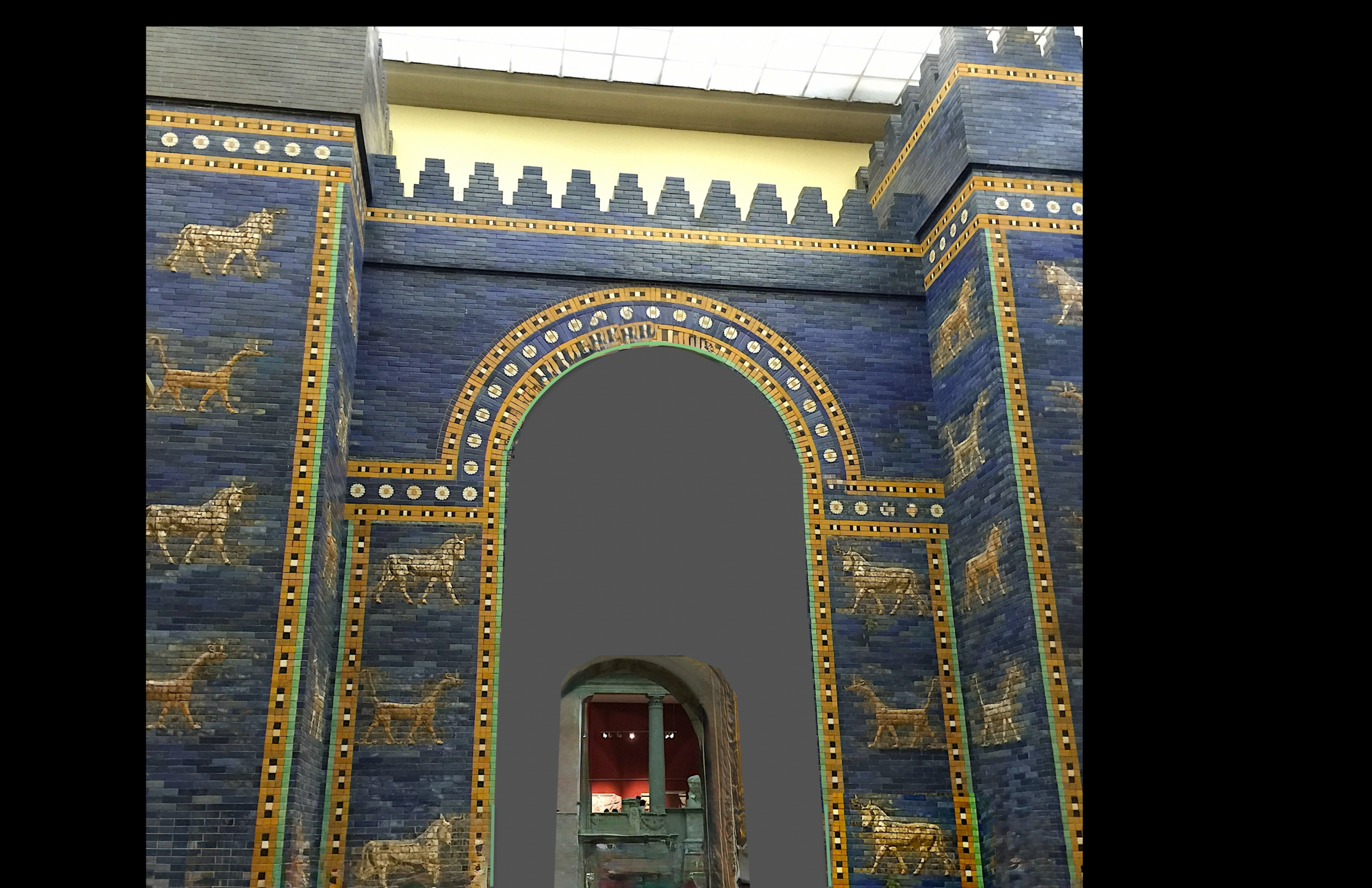
Figure 2. Ishtar Gate at Vorderasistastsches (Pergamon) Museum, Berlin (Photo courtesy of P. Hunt, 2015)
Both decorative and symbolic, these animal figures establish a locus of meaning and power at the threshold of Babylon. Oates writes that “the Gate itself was decorated with “150 bulls and dragons, symbols of Adad and Marduk” and that these animals “appear in the later version of the gate against a backdrop of vivid blue alternating in yellow and white” (Oates 153-155). From this account, each figure is associated with a deity significant to the inhabitants of Babylon and the wider Mesopotamian peoples (Oates, ibid.).
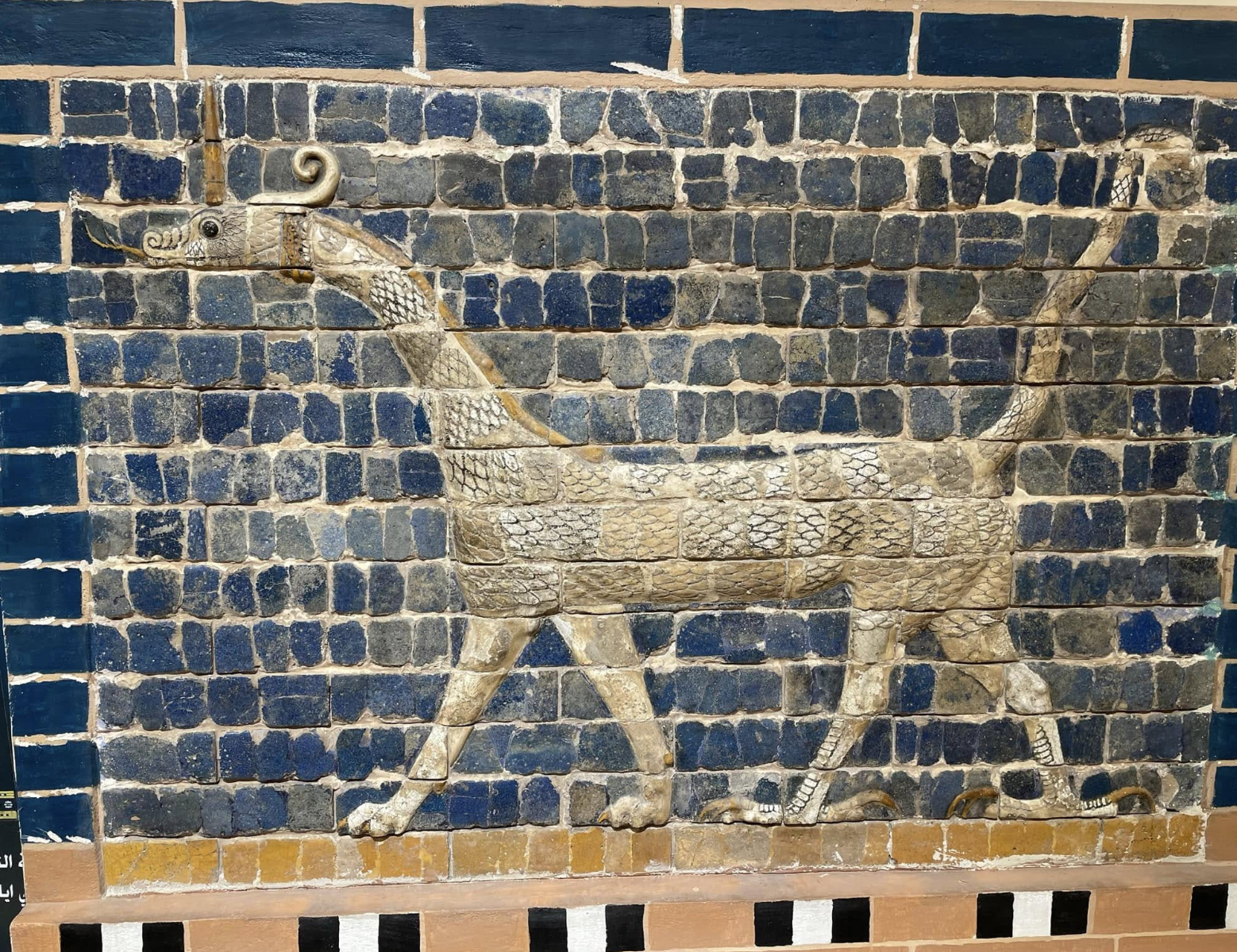
Figure 3. Mušhuššu: Glazed ceramic tile friezes of Nebuchadnezzar II’s Ishtar Gate, Baghdad Museum, Iraq, (Photo in public domain, courtesy of Baghdad Museum)
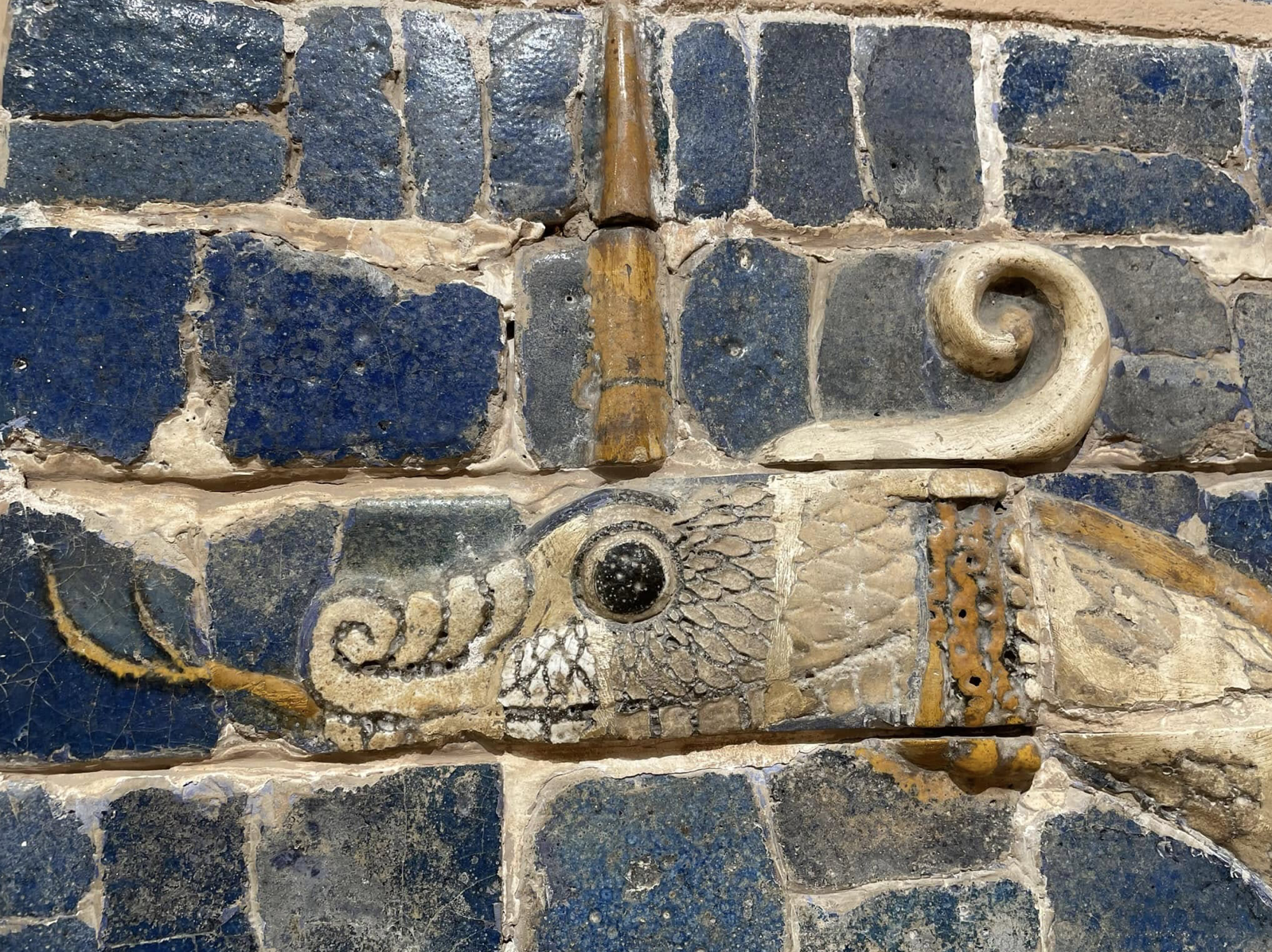
Figure 4 Mušhuššu head and neck, Baghdad (public domain, courtesy of Baghdad Museum)
A reconstruction of a portion of the Ishtar Gate exists at the Pergamon (Vorderasiatisches) Museum in Berlin, Germany (Amrhein and Knott 31). The blue-glazed bricks of mostly copper and cobalt minerals adorn the structure in the deep-blue colors of the sky, the sea, and night. The main portion of the gate, its towers and face, feature processions of bulls and the curious hybrid, the mušḫuššu dragon figure. The other two figures, the lion located along the processional wall and in the case of the bull, on the gate itself, are depicted as strong, mighty creatures, with the innate power they possess depicted in their musculature and powerful poses. However, the bull and the lion are not hybrids. The lion, in Babylonian iconography is associated with the goddess Ishtar, while the bull is an emblem of the god, Adad (Amrheim and Knott 153–155). All three of these emblematic figures appear in procession striding across the blue field made of fired bricks. “Each row consists of the same animals in file: bulls follow bulls, and mušḫuššu dragons follow mušḫuššu dragons (Graff 62). They repeat. For example, as a form of monumental art, they differ from the Panathenaic procession that appears in the Parthenon Marbles (also known as the Elgin Marbles). Those Greek marble figures, however, are individual with differing positions and poses. In contrast, the static Babylonian bulls and mušḫuššu also appear facing both right and left in mirrored positions.
Anatomy and Origin of the Mušḫuššu
What image of the mušḫuššu did visitors encounter when they stood before or walked through the Ishtar Gate? To the ancients, it would have been a familiar figure. To modern eyes, it signifies one of the many hybrid creatures associated with Mesopotamia. The Mesopotamian world is noted for its many hybrid creatures (Black and Green 63-65). Of the hybrids, the mušḫuššu figure is a complex composite creature. Oates describes mušḫuššu dragons as “hybrid creatures, scaly coated, the head bearing the double horns of the Arabian horned viper…the front legs are feline, the hind legs…end in the scaly claws of a bird of prey, and the tail terminates in a scorpion sting” (Oates 162). By her description the mušḫuššu dragon is a rare quintuple hybrid (Oates ibid.).
As a hybrid, the mušḫuššu dragon, of the Ishtar Gate, has an interesting missing feature. Unlike some other Babylonian mythological figures, it has no wings. Babylonian iconography is awash with winged hybrids (Black and Green 63–65, 96-97). There are winged leonine-birds, centaur-like figures, lion-dragons, griffins, bird-men, scorpion-men, and winged genies. Black and Green depict a number of these demon and monster Mesopotamian figures and note that the word demon “has generally been applied to an upright human-bodied hybrid creature, while ‘monster’ has been applied to an animal combination on all fours” (Black and Green 63, 64-65, 96-97). In other Mesopotamian iconography, as a celestial being we rightly expect the goddess Ishtar to be depicted with win gs. The mušḫuššu is not depicted so. It walks on all fours so it is not a demon, nor is it celestial. It is a monster.
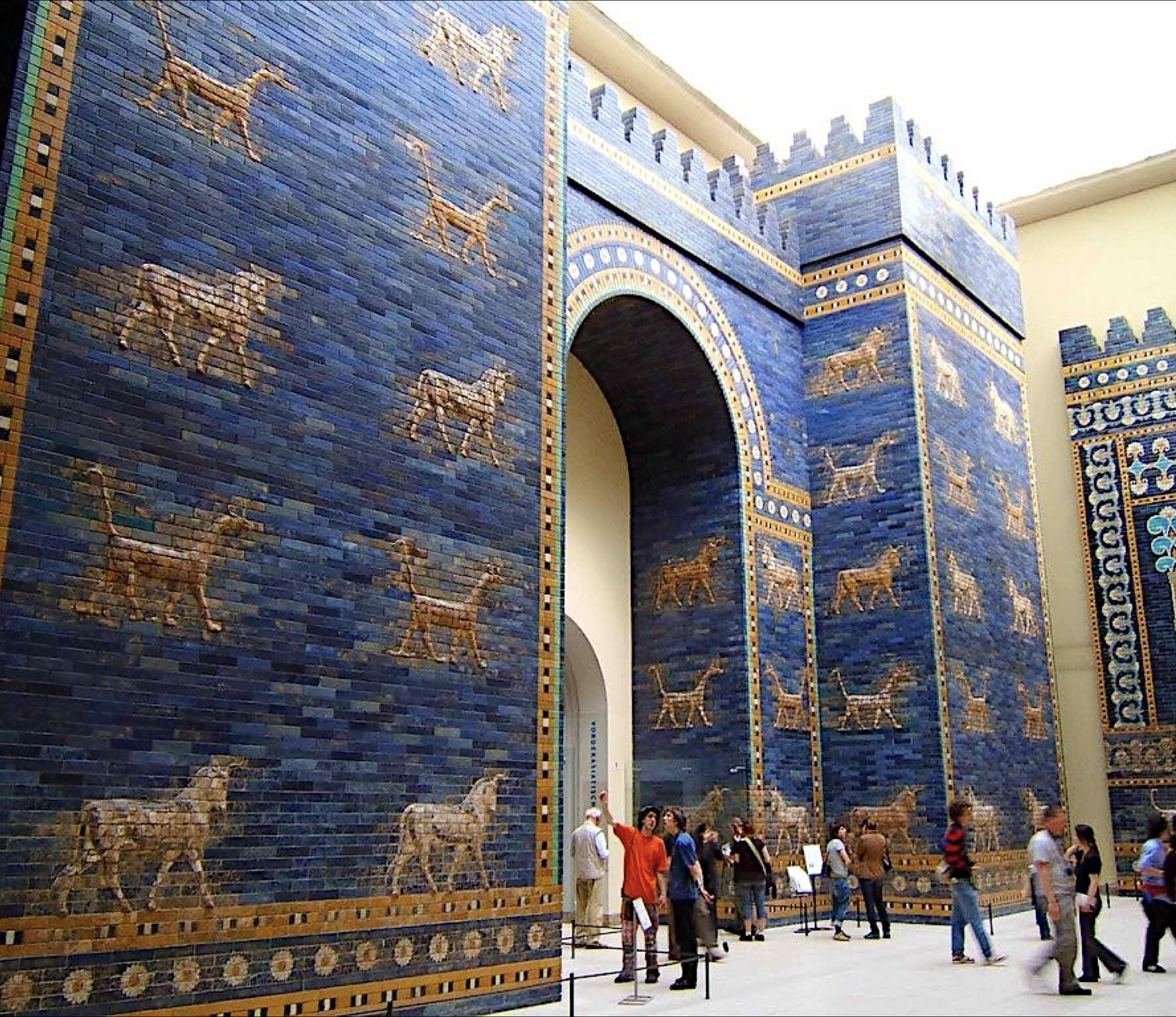
Figure 5, Ishtar gate, with visitors to scale (Photo courtesy of National Geographic)
Citing the Babylonian Epic of Creation, Black and Green attribute the origin of the mušḫuššu dragon to the female deity Tiamat (Black and Green 177). In this origin story Tiamat, who is associated with the (oceanic) salt water that also mingled with the chaotic subterranean waters of her consort Apsu, “created eleven monsters…Eventually, Marduk…defeated the monsters…and destroyed Tiamat.” (Black and Green 177). After Marduk defeated Tiamat’s disorderly demons and monsters, the vanquished mušḫuššu became associated with his power and sovereignty (Black and Green 129). Thus, as part of his conquest, Marduk appropriated the mušḫuššu and made it an emblem of his victory over Tiamat’s chaos.
The Symbolic Logic of the Mušḫuššu
What do we make of this curious composite creature known as the mušḫuššu? That the mušḫuššu figure on the Ishtar Gate is a hybrid is significant in that it differs from the other two emblems, the bull and the lion. What is a hybrid in this context and what does it symbolize? We are familiar with hybrid forms, creatures fused from different animals or human and animal combinations, such as the griffin, the sphinx, or the centaur. These fusions signified something otherworldly, something supernatural. Patrick Hunt, writing about hybrid monsters untangles the complex language of their symbolic existence: While in Classical myth monsters (from monstrare, “to show”) arise out of disrupted nature to punish human hubris on earth—note their likely etymological derivation from the Greek declension of hubris to hybridis. (Hunt 246-247). While the Classical Greek and Roman view of hybrids centered on divine retribution or punishment of human hubris (Hunt, ibid.), the Babylonians and the larger world of Mesopotamia viewed demons and monsters (hybridor not) as supernatural antagonists or divine protectors. The Classical Greek view is similar but with a different focus and shift in emphasis (protection of divine order where hubris breached or suborned the role of the gods).
As to its symbolism, the snake-like form of the mušḫuššu dominates the figure both in size and in its position on the body. In the mušḫuššu, the lion and raptor are positioned below the body, subordinate to the snake. Instead of wings to signify celestial power, its snake-like elements suggest an emphasis on chthonic or underworld power. The mušḫuššu serpent body is not merely one component among several—it is the organizing axis of the creature, while the lion and eagle elements are seamlessly attached to it. This composite anatomy serves as a symbolic aggregation. Each component contributes a distinct protective or divine capacity. Without superseding the reptilian portion of the figure, the lion adds strength and ferocity, while the raptor talons add rapacious tenacity. The addition of the scorpion’s stinger and the horned cap also augment the protective force of the snake-dragon figure. The suzerainty of the snake could symbolize Marduk’s supremacy over other gods, while preserving their ability to work in conjunction as a protective force.
The unique distribution of anatomical features matters. In the mušḫuššu, the asymmetry suggests a hierarchy of symbolic identity: the creature is fundamentally serpentine with terrestrial powers, including the horns and scorpion tail, incorporated into, rather than displacing, its primary nature. Each additional element contributes distinct capacities. Positioned as it is on the Ishtar Gate, it serves a guardian function but what power does it bring and what does it guard against?
The Mušḫuššu as Apotropaic Guardian
Anyone who has visited the British Museum has no doubt seen the monumental Assyrian civic gate eagle-bull (or lion) gate guardians (alad-lammu) sporting their impressive stone wings. The mušḫuššu dragon, though lacking wings, is also a gate guardian and is associated with the god Marduk and the scribe god Nabu (Black and Green, 162,166, 177). The mušḫuššu is classified as a snake-dragon; its name has been identified as Akkadian and means ‘furious snake’ as is appropriate for a protector of thresholds (Black and Green 166). Oates has noted that the Processional Way was “named Aibur-Shabu, ‘the enemy shall never pass’ and that it is along this way that “the images of gods were carried during the New Year Festival” (Oates 152). The emblems of the gods must have been seen as part of that protective force that withstood enemies both natural and supernatural. The Mesopotamian world was awash with adversarial forces. F. M. Wiggerman writes of Mesopotamian rituals that “the gates, rooms, rooms and the corners of the house are occupied by prophylactic figures” serving as protection against “an army of demonic intruders.” (Wiggerman xii). We see in this brief observation that these figures can have an apotropaic function and that the Babylonians feared demonic invasions in their homes and city. According to Black and Green, “The snake-dragon… is represented from the Akkadian Period down to the Hellenistic Period… as a generally magically protective hybrid” that was also “invoked in magical incantations…and figurines of some of them were used in protective magic” (Black and Green 166, 177).
Demons and monsters in hybrid forms could be adversarial or protective. An adversarial monster, once conquered, could be repurposed as an apotropaic figure (such as gargoyles on French cathedrals). Watanabe, writing of the figures on the walls of the Processional Way and adorning the Ishtar Gate, states: “The evidence indicates that the presence of these three animals in this particular architectural context in Babylon focuses on their millennia old protective properties. These animals were chosen to evoke their apotropaic powers in order to avert evil in exactly the same way as when they were stationed as statues at doorways” (Watanabe 222).
One key aspect of the mušḫuššu figure is that the snake portion of its body is the dominant element and central to its identity. In addition, given its conquest by the deity Marduk, it belongs to divine power, serves as the god’s emblem, and thus has a protective/threshold power. The mušḫuššu subordinates terrestrial and aerial predatory powers to a fundamentally serpentine body, converting chthonic danger into apotropaic authority at the threshold of Marduk’s city.
In discussing Sennacherib’s destruction of Babylon in 689, Graff observes that “rebuilding the city was not only a practical necessity, but also a way for its inhabitants to reconstruct the ancient ideological fabric…Babylon was at this time the center of the world’s creation: the place where solid earth first rose from the primordial waters was understood to be located in the courtyard of the temple of Marduk…the act of rebuilding Babylon…was essential to the restoration of cosmic order” (Graff in Amrheim and Knott, 63). A highly suggestive element of the dominance of the snake element of the mušḫuššu, is that it could be seen as protective against subterranean adversaries. In discussing the placement of the figures, Amrhein and Knott state that, “the animals were clearly planned as an entire ensemble, at both the subterranean and aboveground levels (62). The figures of the Ishtar Gate appear below ground and above lending support to the idea that the mušḫuššu could offer protection against underworld enemies. Also, in support of the snake-dragon’s association with waters, including subterranean ones, is the association of the snake-dragon with the underworld deity, Ningishzida, a snake god who is a “guardian over demons” (Black and Green 138-140, 166). In a hymn to the god, mention is made of the “dragon snarling (?) in the lagoon” and the attributes of Ningishzida, in the hymn, include a falcon and leopard (“A Balbale to Ningishzida”). Note a balbale is a type of Sumerian poetic and musical composition. This Sumerian underworld deity Ningishzida with his underworld connotations and vegetative power– sometimes depicted with mating snakes like a kadukeos – has attributes similar to the mušḫuššu figure in hybridizing horned and winged felines (falcon-leopard).
Another path to understanding the mušḫuššu’s protective power as a predominately snake-dominated figure, is to view it from the Mesopotamian view. Irving Finkel, writing of the ghosts that the Mesopotamians feared, noted that alongside ghosts, the Mesopotamians thought they had to contend with “devils and demons” and that they could invoke spells to contend with “any of a group of evil demons” (Finkel 18, 77). The need for a chthonic power to defend against underworldly threats can be inferred from Finkel’s discussion of the Mesopotamian Netherworld. He states that the “Netherworld as a whole is often described as a great city…walled around with gates” (Finkel 266). Below the city that was the center of the Mesopotamian world, another city existed in the Netherworld. Babylonians needed protection from terrestrial adversaries and also those from the subterranean underworld. The mušḫuššu offered protection against both. The terrestrial lion and raptor claws could rend and tear. The snake could launch poison sprays at its enemies and the scorpion tail stinger could poison enemies not only earthly but those of the Netherworld.
Establishing a Sacred Precinct by Embodying Marduk’s Protection
How does the mušḫuššu make the Ishtar Gate a ritual, political, and spiritual architecture? Once vanquished with Tiamat and adopted as an emblem, the mušḫuššu carried Marduk’s presence and sovereignty into public space. Given its protective function and symbolic association with Marduk, the mušḫuššu, announces with its presence, a sacred precinct under Marduk’s protection. It marks a transition from ordinary civic spaces into a space that is divinely ordered.
Ishtar Gate mušḫuššu frieze (Photo courtesy of P. Hunt, 2016)
Conclusion
The mušḫuššu of the Ishtar Gate transformed Babylon’s principal entrance into a visible manifestation of divine kingship and cosmic order. As an emblem of Marduk’s sovereign authority and herald of his active presence, the snake-dragon allows Marduk’s authority to become visibly present without depicting Marduk himself. In this way, the mušḫuššu can be seen as an active participant in creating sacred threshold space that everyone who passed into Babylon through this gate would experience. That the mušḫuššu dragons were important to the Babylonians, is without question. Nebuchadnezzar II mentioned them in his inscription plaque on the Ishtar Gate: “Upon the walls in the inner room of the gate are bulls and dragons and thus I magnificently adorned them with luxurious splendour for all mankind to behold in awe” (“Nebuchadnezzar’s Inscription Plaque”). Scholars have long noted Babylon’s mušḫuššu dragons, described them, and analyzed their construction in detail. However, little attention has been paid to the physical proportions and arrangement of their hybridity. The mušḫuššu snake dragon anatomy and proportions offer another view of their symbolic representation and protective function. As discussed, the dominance of the snake form over its lion, raptor, and scorpion elements, offer a tantalizing indicator that points to the snake-dragon’s watery and divine origins. The bull and lion figures as totemic rulers of the land on the Ishtar Gate, are firmly grounded in the terrestrial. They protect the city from that which appears above ground. The mušḫuššu dragon is thus not only a protector of the threshold gate, as a snake, it crossed liminal boundaries between earth and water, above ground and below ground. It is significant that the Ishtar Gate stands near bodies of water such as the Euphrates and was built in part “to abate rising groundwater” (Amrhein and Knott 28, 30). The gate reaches to the sky, stands firmly on earth, and reaches below ground touching water. The mušḫuššu thus provides protection across these domains. It protects from earthly enemies, watery adversaries, and perhaps even against the demons of the underworld from whence it came.
Bibliography
Amrhein, Anastasia, Fitzgerald, C. and Elizabeth Knott. A Wonder to Behold: Craftsmanship and the Creation of Babylon’s Ishtar Gate, edited by Anastasia Amrhein, Clare Fitzgerald, and Elizabeth Knott, Institute for the Study of the Ancient World, New York University / Princeton University Press, 2019, “Introduction”, 25–38.
“A Balbale to Ningishzida (Ningishzida B): Translation.” Mesopotamian Gods, ETCSL (Electronic Text Corpus of Sumerian Literature) Oxford University. https://www.mesopotamiangods.com/balbales-to-ningishzida-ningishzida-a-translation/.
Black, Jeremy, and Anthony Green. Gods, Demons and Symbols of Ancient Mesopotamia: An Illustrated Dictionary. University of Texas Press, 1992.
Finkel, Irving L. The First Ghosts: Most Ancient of Legacies. Hodder & Stoughton Press, 2021.
Graff, Sarah B. “Layout and Composition of the Animals from the Ishtar Gate and Processional Way at Babylon.” In A Wonder to Behold: Craftsmanship and the Creation of Babylon’s Ishtar Gate,
Anastasia Amrhein, Clare Fitzgerald, and Elizabeth Knott, eds., Institute for the Study of the Ancient World, New York University, distributed by Princeton University Press, 2019, 61–71.
Hunt, Patrick. “Dante’s Monsters in the Inferno: Reimagining Classical to Christian Judgment.” Critical Insights: The Inferno, Patrick Hunt, ed. Salem Press, 2012, 246-247.
Brittany Garcia. “Nebuchadnezzar’s Inscription Plaque.” World History Encyclopedia, 2013.(https://www.worldhistory.org/image/2990/nebuchadnezzars-inscription-plaque/).
Oates, Joan. Babylon. London: Thames & Hudson, 1986.
Watanabe, Chikako E. “The Symbolic Role of Animals in Babylon: A Contextual Approach to the Lion, the Bull and the ‘Mušḫuššu.’” Iraq 77 (2015) 215–224.
Wiggermann, Frans A. M. Mesopotamian Protective Spirits: The Ritual Texts. Groningen: Styx Publications, 1992.