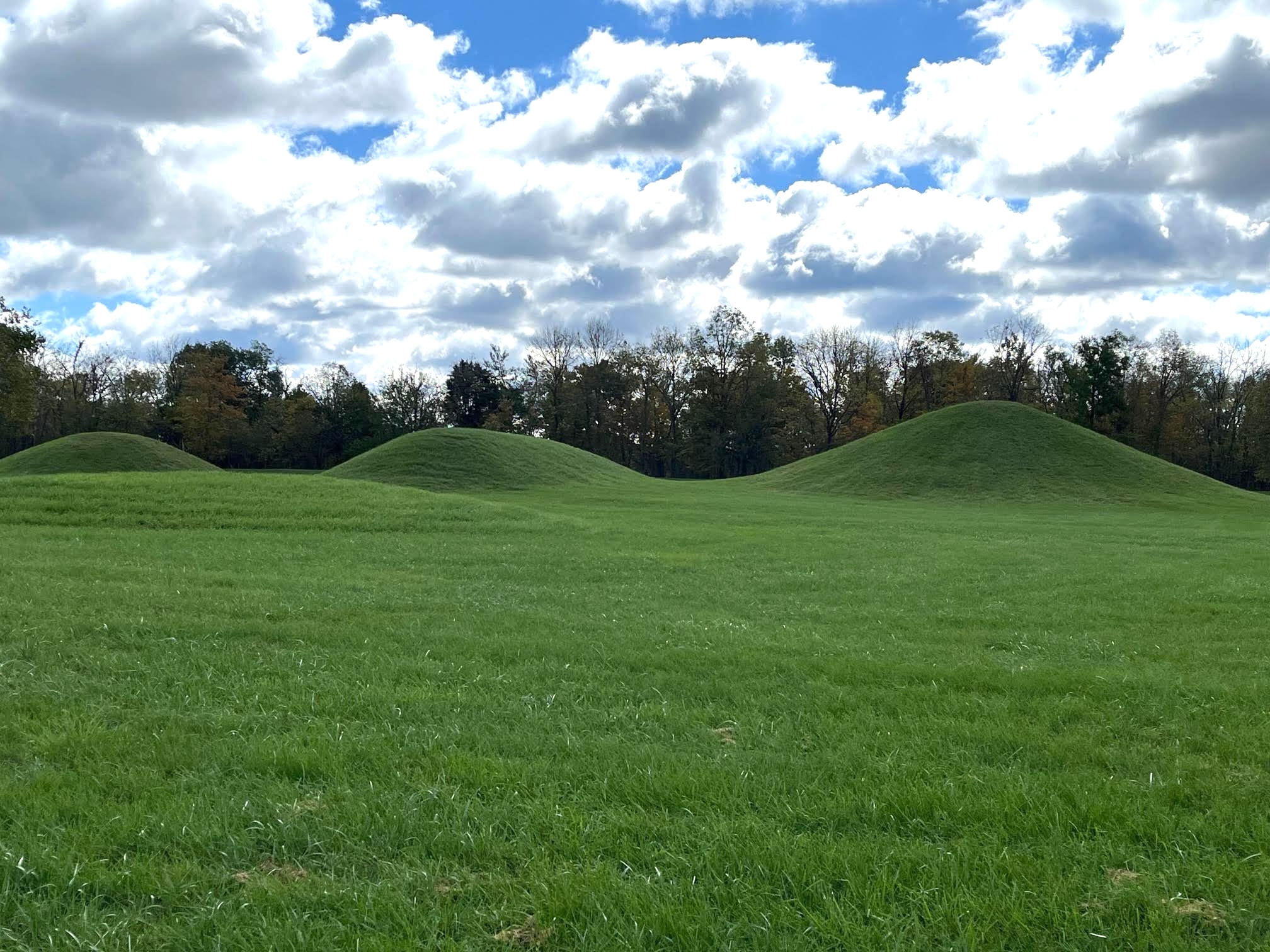
Hopewell Mounds, Ohio (Photo Sara Olsen)
By Sara Olsen –
As we celebrate 250 years as a nation, we must also reflect on the cultures living on the land before this nation existed. One such culture was the mysterious Hopewell. The Hopewell was a mound building culture which developed along the Ohio River and its tributaries during a period of time after the Early Woodland/Adena Period timeframe of about 800 BCE to 100 CE and thrived in the Middle Woodland/Hopewell timeframe of 100 BCE to 500 CE (Lute 2017). The Hopewell occupied southern Ohio River valleys and produced the most elaborate artifacts and large Earth constructions of all the prehistoric cultures of the Eastern United States. Their trade networks brought a variety of exotic materials from far away sources: copper from Lake Superior, mica from the southern Appalachians, Gulf Coast and Atlantic marine shells that artisans made into ornaments and objects used for special occasions and social status. Significantly, the Hopewell mounds had very complex earthworks which enclosed hundreds of acres of land. Their earthworks were built in geometric shapes, circles, squares and polygons in the broad river valleys. The geometric and hilltop enclosures required considerable organization of labor and planning as well as a knowledge of astronomy.
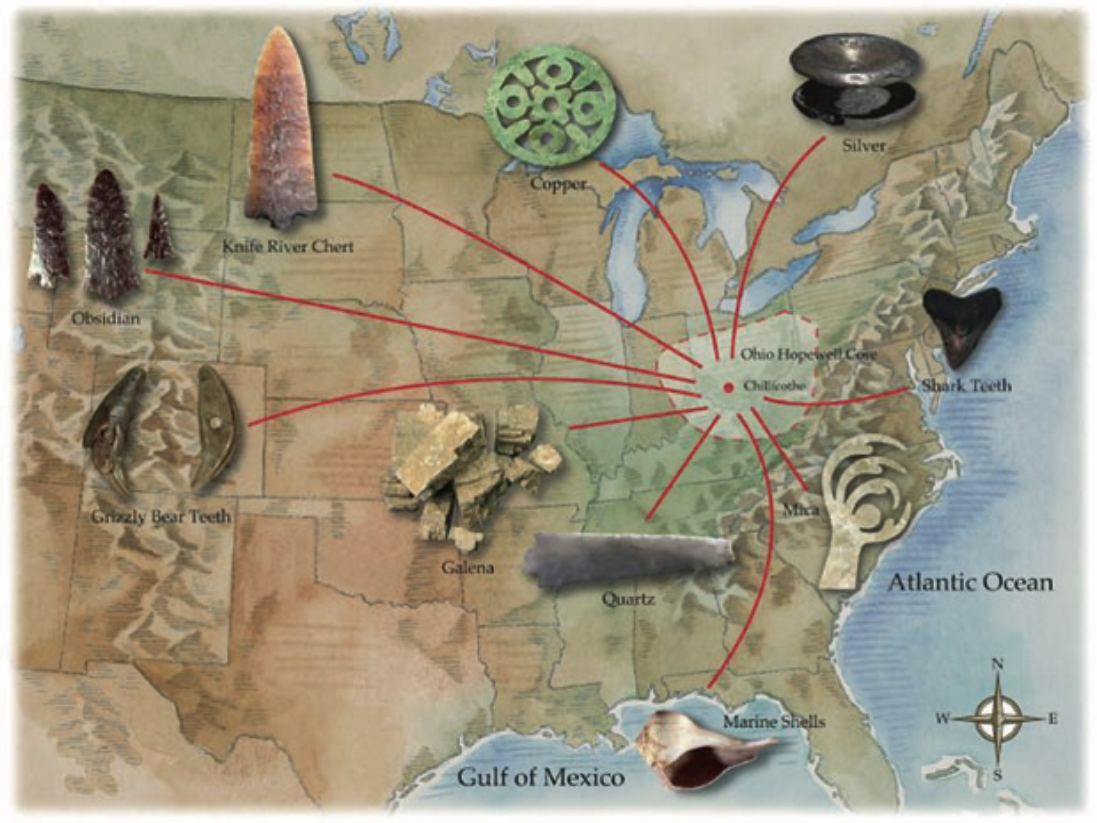
Map of Hopewell Culture Sphere of Interaction (courtesy of Lepper, 2017)
The question of origin of the Hopewell people has historically been met with varying perspectives and range from series of “giants with archaic features of protruding brow, sloped forehead and a double row of teeth” (Zimmerman, 2021, 270) to ‘the Book of Morman [sic]” stating there were 50 correlations of the Hopewell and Nephites. Other suggestions ranged from comparing them to the Beaker people of the British Isles, to the Phoenicians, Hindus, Vikings, Welsh Canaanites and to those from Atlantis (Horwitz, 2009, 237). However, according to the American Journal of Human Genetics 70 (2002) 192-206 studies strongly suggest there were at least two coherent waves of migrations for both males and females through Beringia of the Siberia Kamchatka-Chakotsky peninsula and Alaska’s Seward peninsula when a flat stretch of “more than 1000 miles wide appeared” and allowed for migration (Mann, 2011, 177). More migration may have happened after the last Ice Age ~11,700 BP / kya to as far southward as Southern Chile (Plog, 2014, 37). Ancient populations expanded rapidly across the Americas about 13,000 years ago (Wade, 1986, 2) and show that “the native Americans did originate in the Americas as a genetically and culturally distinctive group…absolutely indigenous to this continent” (Wade, 3). Another more recent migration from about 1300 years ago has shown that dispersal “spread across the continent into the Caribbean, and show hints of being related to Mesoamericans from Central America and Mexico” (Wade, 4).
Surprisingly, the Hopewell and Mesoamerican societies appeared to occupy their place in time with shared cultural traditions, a “cosmological mode of thought that found order, coherence, and meaning in the integrations of human society and the larger structures seen and experienced in the natural environment” (Sharp, 20). Their leaders must, by religious practices, ensure solid fertility, season progression, and enough plants and animals to guarantee the peoples’ prosperity. This mandate was done through art, rituals and to some respect architecture (including mounds). The Hopewell people and Mesoamerica appear to have been culturally linked in this way. For example, to the Hopewell, Earth was a circular shape with “cardinal and inter-cardinal points, emphasizing the overarching East-West line of the sun” (Townsend and Sharp, 21). Observance of sun cycles made possible the creation of the calendar for ceremonies and plantings. The Maya also “developed and perceived a cosmos that needed to be ordered and maintained” (Coe and Houston, 2022, 56). They developed a calendar for agriculture and priests appear to be among the first systematic astronomers. The engineering of the Hopewell mounds allowed a “complex, mathematically aligned mix of squares and circles that apparently functioned as lunar observatory” (Graber & Wengrow, 2021, 459). The Hopewell had a new metric system of measurement and a “new geometry of forms” (Graber & Wengrow, 459)
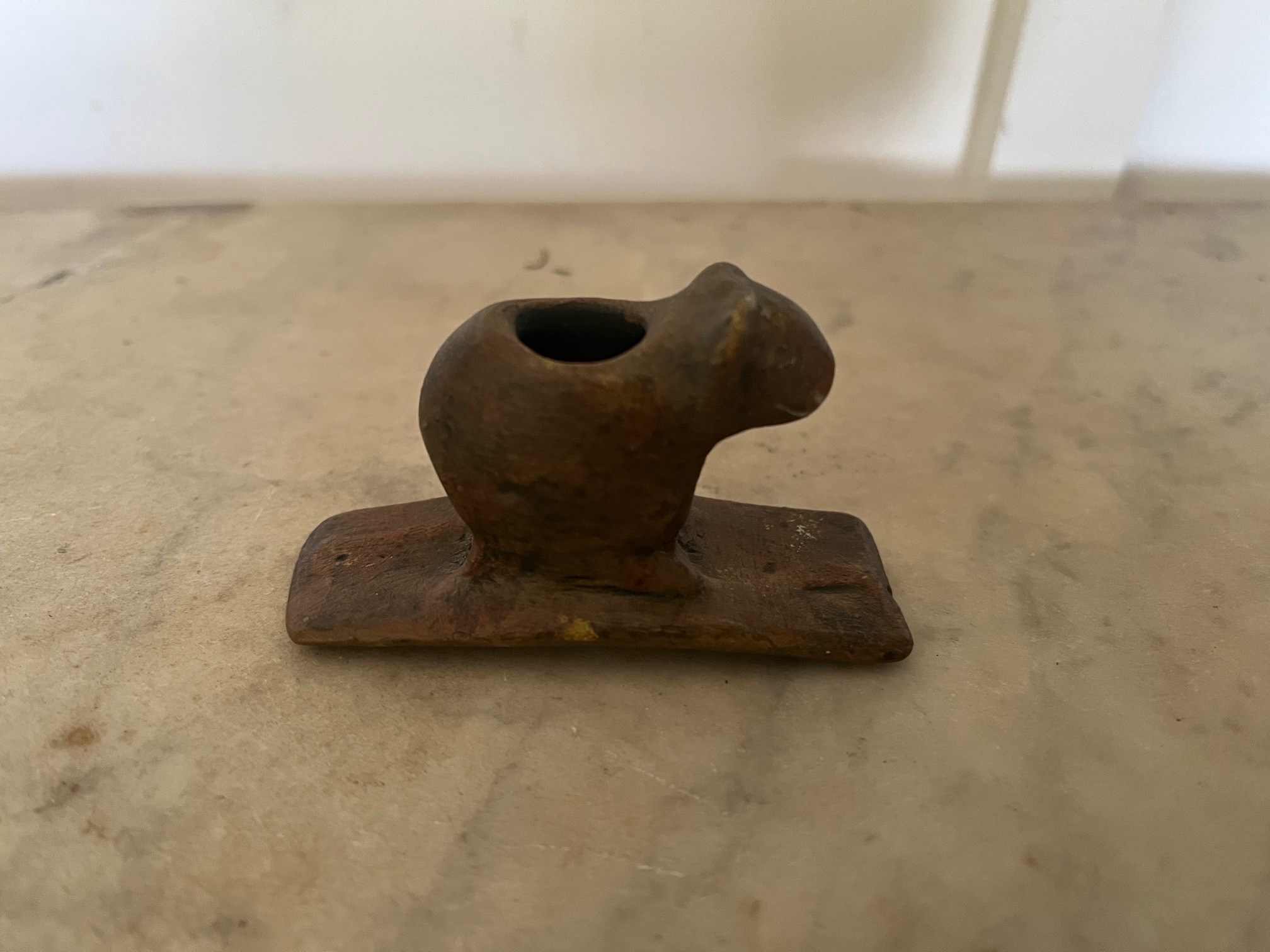
Hopewell Culture Stone Bear Effigy Pipe (Photo S.Olsen)
In the Hopewell culture, art and animal imagery were associated with nature and used in rituals such as shown by the abundance of stone effigy pipes from the Hopewell burials. In the Scioto River valley near the town of Circleville, Ohio, so named because of its original construction within a great circular Hopewell mound, crops grown were sunflowers, pumpkins and squash, quinoa and tobacco which contained more nicotine then than the present. They had no corn or maize or beans (interview, Clarke-May Museum, October 2024). Their tobacco, stronger than commercial tobacco today, contained 5-10 time more nicotine, making it psychoactive (Mann, 2011, 292). The small stone pipes were carved into animal shapes with the animal usually facing the smoker. The Shamans or gatekeepers who smoked these pipes with the powerful tobacco used the animal effigies to summon the guardian spirit for their help and protection for entry into the spirit world. (Lepper, 2005, 124). Shamans were often represented as wearing deer antler headdresses and bear skins (Lepper, p.123) as connections to the animal world. Other stone technology included “small, thin blades struck from specially prepared conical blocks of flint” (Lepper, 122). These bladelets were found both at habitation and ritual sites. The special cores of flint, most likely from Flint Ridge in Licking County, Oho, were struck in a special way, to get the most from a cutting edge with the least amount of flint. They appear to have been used until they wore out and were easy to carry on the trade trails, The flint used was brightly colored and, when heated, it was a way to bring out the colors of red, white, blue, green gray and black as well as easier to fashion into tools (Lepper, 123). Other art came from trade items like shells, pearls and teeth. They also had raw copper anthropomorphic effigy face masks, showing their copper smelting technical capabilities, with sources from a range of distances including the Great Lakes, especially Lake Superior (Hinkelman, 2022).
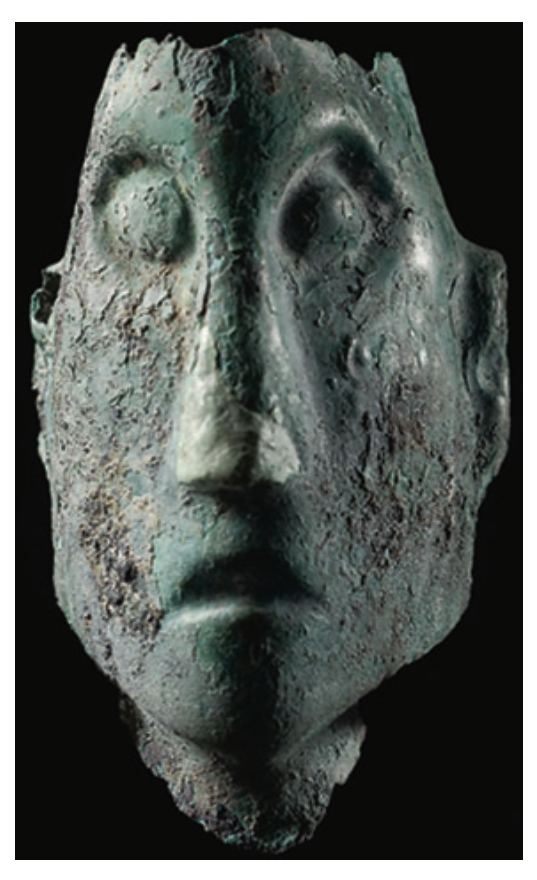
Hopewell Culture Copper Effigy Mask (courtesy of Lepper 2017)
Other Native American mound sites like Cahokia in Southwestern Illinois – eastward across the Mississippi river from St. Louis – share features and possibly cultural affinities with the Hopewell culture, although Hopewell would be mostly an antecedent and Cahokia may be derivative of it. From around 600-possibly 1200 in the Late Woodland Period, Cahokia reached its zenith around 1100 CE, was spread over at least 2000 acres and may have supported at least a population around 20,000 with around 120 earthworks. (Cahokia Mounds Museum and Interpretive Center), (Benson & Pauketat et al., 2009).
Many sites were “cosmic centers for ritual performances” with some collective ethos that larger groups were meant to attract “spiritual powers” and reflect the human-animal relationship (Townsend & Sharp, 2004, 65-71). By CE 200, the Hopewell had built sacred, ceremonial centers covering hundreds of acres. Trails and pathways connected to the sacred structures. Enclosures had appeared by at least 400 BCE (Townsend & Sharp, 67). The basic square and circle was an iconographic module lasting into the Mississippi times (Townsend & Sharp, 68). William Romain in his observations of the Newark earthworks (now an UNESCO site) noted that the circumference of the Great Circle was almost equal to the perimeter of the square, a geometric exercise of “squaring the circle” (Romain 2000; Townsend & Sharp, 75), a concept found at Stonehenge and the Great Pyramid. The small town of Circleville, along the Scioto River, and built inside a great circular mound, also squared the circle when it destroyed the circle in 1837 because it was “silly” and reverted to a square grid system.
Fortunately, we have a brief history of early destroyed mounds because of the interest of significant people like Thomas Jefferson. Jefferson wrote ‘Notes on the State of Virginia’ in 1785 after seeing the number of southern mounds, wherein he realized the importance of detail work rather than a way to find treasure. His work is regarded as the first scientific archaeological publication in the new world (Silverberg, 40). Thankfully, too, we have a brief history due to amateur surveyors such as Caleb Atwater (1778-1867) who lived in Circleville, Ohio, along the Scioto River. He was a lawyer, postmaster and a member of the Ohio legislature, but most of all an amateur archaeologist. His book, “Antiquities Discovered in the State of Ohio” published in 1820, was speculative with little knowledge of the temporal framework of the time. Careful fieldwork and systematic description were not common practices. One of Atwater’s important finds, however, in the Circleville circular mound (there was also a square mound) was a very large and very elegant isinglass (mica) mirror placed over the skeleton of a man (Atwater, 1820, 225).
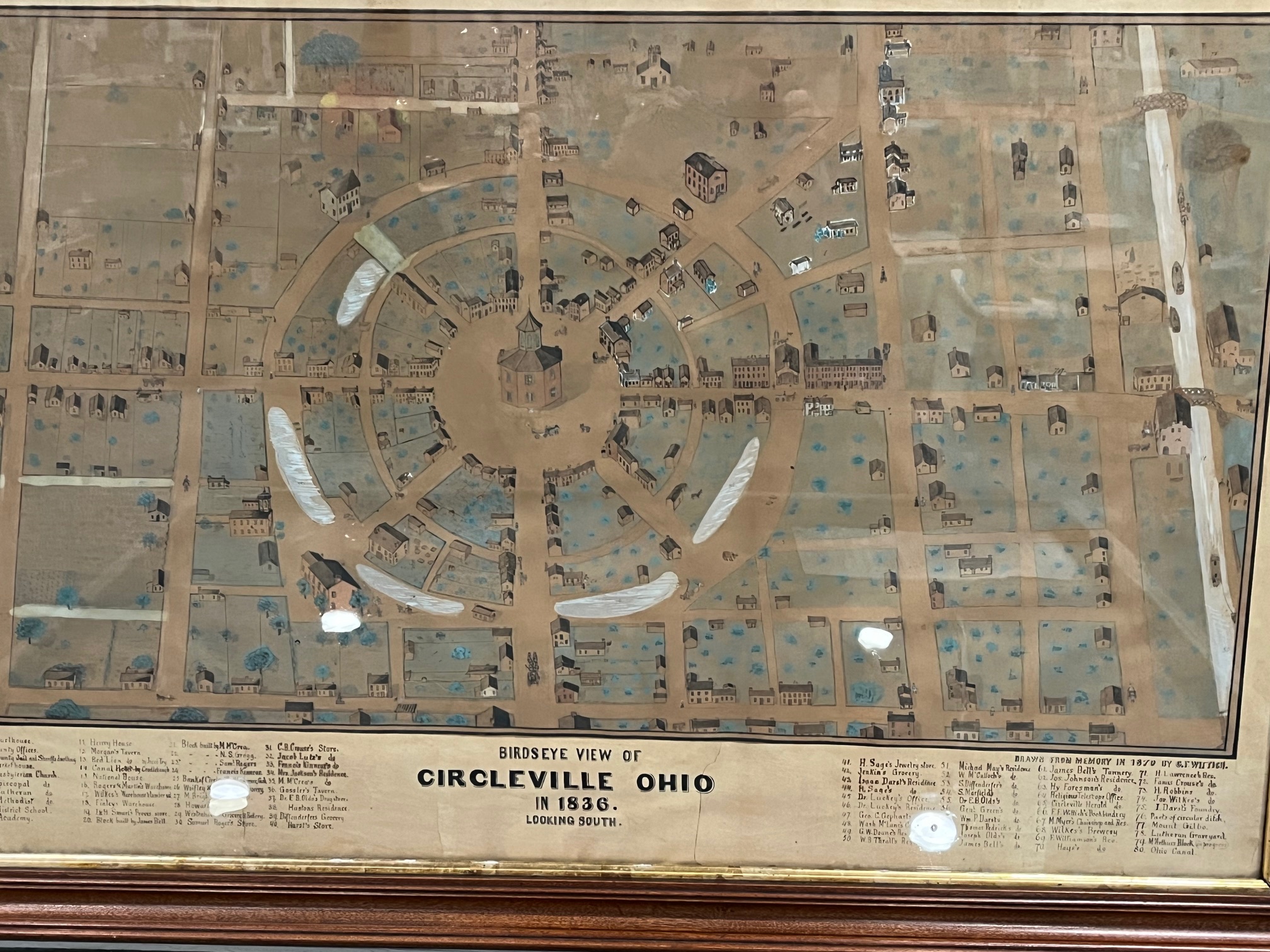
Atwater suggested that the Circleville mounds are “similar to the most ancient ones to be seen in Mexico” (Atwater, 245). They were ‘Teocalli’ or mansions of the Gods. The large sheet of mica showed that it “highly probable…that it was to be used as a mirror” (Atwater, 246). It was like “one of the three principal Gods of the South Americans…called Anahuac or the God of the Shining Mirror” (Atwater, 247). This God reflected his own supreme reflection and enjoyed perpetual youth and beauty. Atwater expressed doubts as to whether the ‘Aboriginies’ who settled along the Scioto River were capable of constructing the existing mounds. He once said that he did the best he could in his power to preserve the mounds, and thankfully we have his survey work today. Years later, Ephraim G. Squier, a newspaper editor in Chillicothe, Ohio, south of Circleville and home to a large mound complex now a part of UNESCO, and Edwin H Davis, a physician, teacher and amateur archaeologist, systematically mapped mounds and published “Ancient Monuments of the Mississippi Valley” in 1848. They, too, thought the Hopewell mound builders were connected to Mexico and Peru (Meltzen, 36). Unfortunately Squier and Davis became embroiled in a dispute and their valuable artifacts were sold and later donated to the British Museum. Squier and Davis agreed that the mica mirror in the Circleville mound appeared to be consecrated to some religious purpose although it was equivalent to the Mexican Tezcatlipoca, ‘Lord of Light’ (Squier & Davis, 1848, [1948] 285). They suggested that the native peoples “are not of the American race, but more particularly of the family which denominates the Toltecan and the Peruvian type. The cranial internal capacity might have been affected by Peruvian and other practices of moulding infants heads by lashing them to a board on their back.”(Squier and Davis, 89-90). In their time, Squier & Davis, debating the idea of how these mound came to be, also wrote a notification of what might have led to the Hopewell’s decline in the area and replaced later by other native tribes. In their Ancient Monuments book they referenced a historical event of a comet airburst over the area that happened between 200 BCE and 500 CE. Later, with new techniques for examining such event, a chemical footprint on the ground showed traces of platinum and iridium, rare elements. Further evidence by radiocarbon dating and topological dating showed an estimate of the event happening around 252-383 CE (Gamillo 2022). The shock waves and heat generated must have devastated the landscape including agriculture and probably trade. The micrometeorites that fell were used by the Hopewell for jewels and pan flutes. Another evidence of the cosmic event is the Hopewell construction of a comet shaped mound near the epicenter of the event and close to Chillicothe called the Milford Earthworks which may have been built to recognize the event.
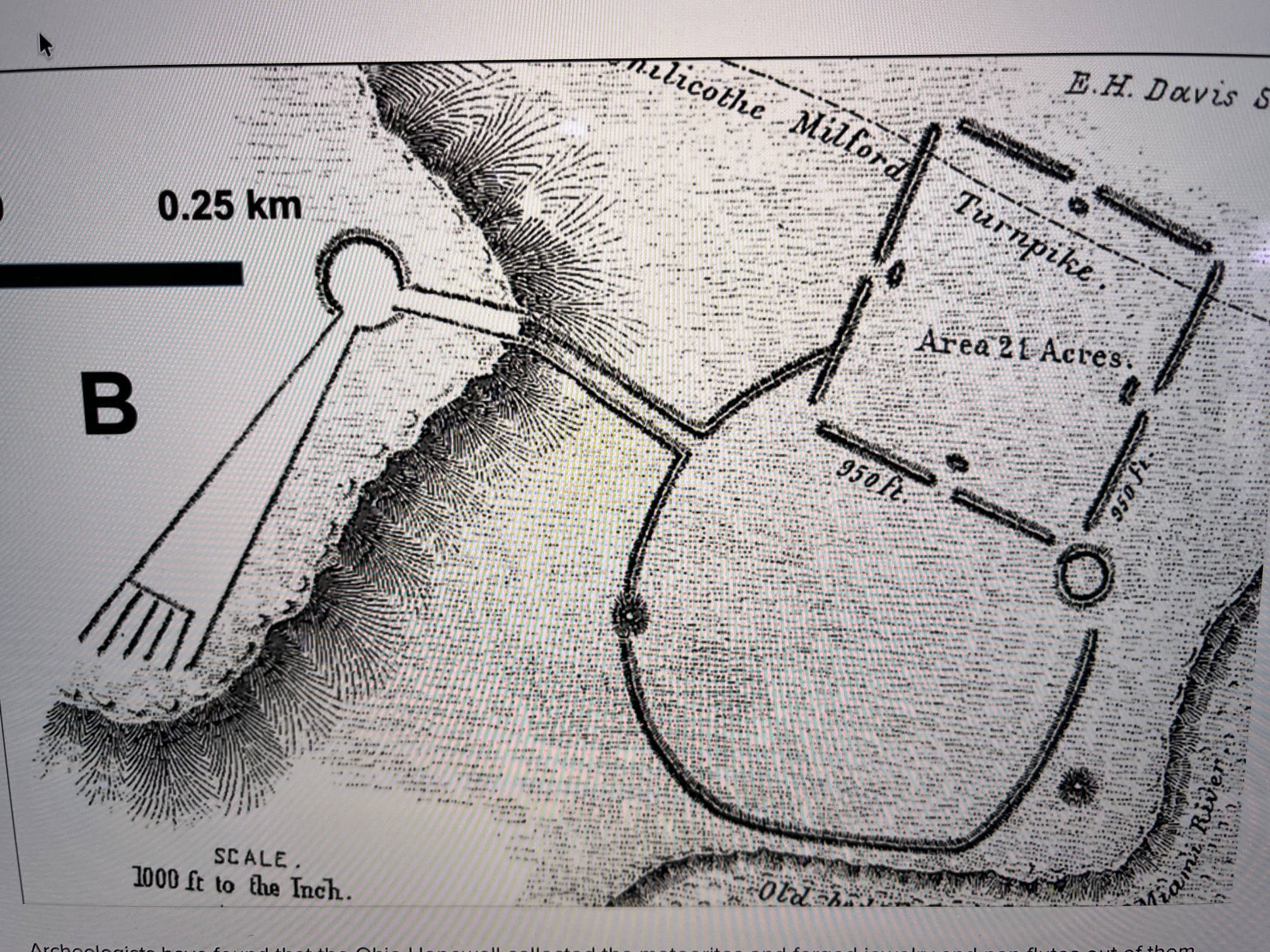
Illustration of mound built to document comet airburst during Hopewell time (a widely-accepted hypothesis). Milford Earthworks, Ohio
Although many similarities exist as to connections of Hopewell and Mesoamerica culture, one fact must be considered. How did these people connect, if they in fact did? Trade and trails seem to be a possibility. Trails connecting distant parts of the Americas, including the Warrior Trail, that connected complexes for whatever reason, allow the idea that many Hopewell sites were built to be pilgrimage centers for religion, trade, warrior games or mourning ceremonies. Archaeologist Bradley Lepper of the Ohio Historical Society proposed there was a “Great Hopewell Road” which once ran from the octagonal ‘Observatory’ at Newark, Ohio, to its astronomical counterpart at Chillicothe, south of Circleville. This would allow a Hopewell astronomer-priest to chart the skies and could accomplish an ideological meeting of the minds. Lepper found historical records and used aerial images that suggested parallel walls started at Newark and went approximately 60 miles to the southwest connecting to ceremonial centers of the Scioto River valley near Chillicothe (Lynott, 2014, 86). When used as a pilgrimage trail, there could be an exchange of knowledge as well as of trade goods. There might be a cultural force to create a society of landscape builders capable of building large earthworks or hundreds of small earthen monuments. Therefore, the indigenous people could have been quite capable of building mounds for pilgrimage sites designed to honor the Gods, trade or plant crops, mourn, enjoy games or just to socialize. The Hopewell have left their legacy in their earthworks. Whether they received their knowledge from other cultures like Mesoamerica or developed it themselves, we can’t be sure. They appeared, built their culture, and gradually disappeared, maybe heading south and west on the great rivers, perhaps to the city that became Cahokia, mentioned above as a larger Mississippian network. Fortunately, in 2023, UNESCO identified the Hopewell Culture Mounds as Ohio’s first UNESCO World Heritage Site and the United States’ 25th UNESCO site, preserving what is left of the Hopewell culture in Ohio for further study, which may eventually resolve the Hopewell enigma.
Bibliography
Atwater, Caleb. Antiquities Discovered in the State of Ohio and other Western States. Intro. by Jeremy Sabloff, Commonwealth Book Company, St. Martin, Ohio. 1820 Originally published.
Bain, Paul, Editor. Archaeology, Smithsonian Books, Washington, DC. 2017.
Benson, L.V., Pauketat, T.R., Cook, E.R. “Cahokia’s Boom and Bust in the Comtexts of Climate Change.” American Antiquity 74.3 (2009) 467-83.
Cahokia Mounds World Heritage and State Historic Site (https://cahokiamounds.org).
Clarke-May Museum, John Mylett and Dr. Jeff Bowen interview 10/14. 62 W. Union St., Circleville, Ohio 43113. Pickawayhistorical/society.org.
Coe, Michael and Houston, Stephen. The Maya. Thames and Hudson, London and United States. 2022.
Gamillo, Elizabeth. “Scientists Fine ‘Chemical Footprint’ of Comet Airburst that may have ignited the Decline of Hopewell Culture”, Smart News, Smithsonian Magazine. Feb. 7,2022.
Gelber, Ben. “Circleville Native American Artifacts Collection, Pickaway County, 10/28/23.
Hinkelman, Sarah. “Hopewell Culture Copper”. Hopewell Culture National Historical Park, National Park Service, 2022.
Horwitz, Tony. A Voyage Long and Strange, Henry Holt and Co., Picador, New York, 2009.
Hunt, Patrick. “Cradle of Civilization:Mesoamerica and Peruvian Archaeology” Lecture Stanford University, Palo Alto, CA. 4/21/26.
Knoji. “The Hopewell Tradition and the Spread of Indigenous Ritual Across North America”, access 6/26/24.
Lepper, Bradley T. “Ohio Archaeology”, Ohio Archaeology Project, Voyager Media Group, Inc., Orange Frazer Press, Wilmington, Ohio. 2005.
Little, Gregory. “The Illustrated Encyclopedia of Native American Mounds and Earthworks”, Eagle Wing Books, Inc., Memphis, TN. 2016.
Lute, Maria and Dale, Finding Ohio Mounds, A Guide to the Ancient Earthworks of Ohio, Sacred Truths, Lexington, KY. 2017.
Lynott, Mark J. Hopewell Ceremonial Landscapes of Ohio. Oxbow Books, Oxford, England and Havertown, PA. 2014.
Maclean, J.P. “The Mound Builders”, Alpha Editions, Historical reproduction. 2021.
Mann, Charles C. 1491, New Revelations of the Americans Before Columbus, 2nd Ed. Vintage Gooks, A Division of Random House, New York, NY. 2011.
Miller, Mary Ellen. The Art of Mesoamerica. Thames & Hudson, London, 2019.
Plog, Stephen. Ancient Peoples of the American Southwest, Second Ed., Thames & Hudson, London. 2014.
Silverberg, Robert. The Mound Builders, abridged Edition of ‘The Mound Builders of Ancient America”, Greenwich, Conn., New York Graphic Society. 1970.
Squier, Ephraim G. And Davis, Edwin H. Ancient Monuments of the Mississippi Valley, Smithsonian Classics of Anthropology, Smithsonian Books, Washington,DC (1848), Intro. 1948.
Redman, Brian, Ruby, Bret, Burks, Jarrod. Encountering Hopewell in the Twenty- First Century, Vol. 1. The University of Akron Press, Akron, Ohio. 2019.
Romain, William F. Mysteries of the Hopewell, the University of Akron Press, Akron, Ohio. 2000.
Townsend, Richard F.,Sharp, Robert V. Editors. “Hero, Hawk, and Open Hand”, The Art Institute of Chicago in Association with Yale University Press, New Haven and London. 2004.
UNESCO. Guide to the Hopewell Ceremonial Earthworks, third edition. 2023.
Voorhies, Barbara, Ed.(Gutierrez). Prehistoric Games of North American Indians, The University of Utah Press, Salt Lake City, Ut. 2017.
Wade, Edwin, ed. The Arts of the North American Indian: Native Traditions in Evolution. Hudson Hills, 1986.
Weingartner, Tana. “Ohio’s Hopewell Ceremonial Earthworks are about to be a UNESCO World Heritage Site” NPR Weekend Edition. 9/16/23.
Willey, Gordon. Pre-Columbian Civilization: Mesoamerican Pyramids, Britannica Editors. Access 5/21/26.
Zimmerman, Fritz. The Encyclopedia of Ancient Giants in North America, Las Vegas, NV. 2021.